A hotel furniture delivery is a data problem before it is a truck problem. A shipment can meet its contractual delivery point and still be unusable for installation if the receiver cannot route its packages to room 412.
The fix is not a bigger packing list. It is a mapping that survives the trip: every piece has an item identity, every package has a unique identity, and each ordered unit is allocated to a room type and position, with central spares identified separately. Batches then follow the approved revision, and receiving checks the mapping rather than the pallet count.
Split the Order by Room Type, Floor and Phase
A single “furniture” shipment usually contains several different delivery problems. King and suite layouts can both repeat, but their item allocations differ, and public areas may be installed by another team. Split the order before it reaches the container.
| Room type | Keys | Physical rooms | Typical package | Batch |
|---|---|---|---|---|
| King | 60 | 60 | Bed, two nightstands, desk, chair, dresser, mirror | B1 |
| Twin | 30 | 30 | Two beds, two nightstands, desk, chair, dresser, mirror | B1 |
| Suite | 6 | 12 | King set plus living seating, tables and dining chairs | B2 |
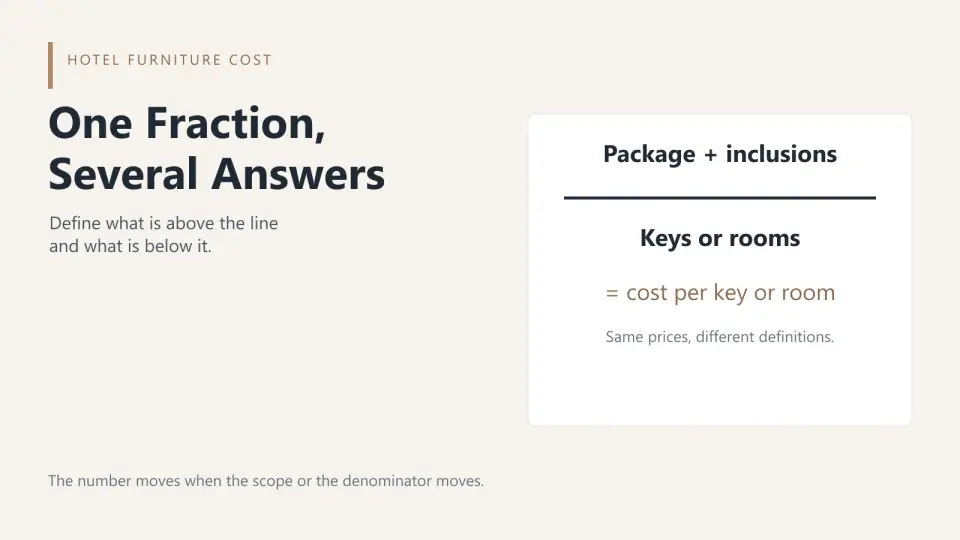
For this hypothetical plan, a suite counts as one key but contains two furnished bedroom or living-room spaces, excluding bathrooms and circulation. That gives 96 keys and 102 spaces, called “physical rooms” in the table. This is a stated allocation convention, not a second standard hotel room count. Use room IDs and item quantities to plan packages; neither key count nor space count alone establishes the number of packages.
Floor and phase matter as much as room type. A 12-floor tower may need the furniture staged by floor to keep corridors clear, and a phased opening may need the same room type delivered in two waves. Add floor and phase to the matrix, even if they are not in the purchase order. The Room-By-Room FF&E Checklist shows how the package divides by room and area; the delivery matrix follows the same units.
Release a floor shipment against site readiness: finished surfaces, protected access, an available elevator and a receiving crew. If construction slips, compare the cost of warehouse storage with the rehandling and damage exposure at site. An incomplete room kit may justify an early delivery when the missing item can be installed later without blocking other work; record that exception and its second handling cost instead of calling the room complete.
Give Every Piece Three Identities
Most receiving failures start with one identity doing three jobs. Separate them:
-
Item identity. The item ID from the purchase order and shop drawing:
K-DESK-01, revision B, finish F-03. This is what the factory makes and what the warranty covers. -
Position identity. The room type and position: king room, desk, against the window wall. This is what the installer needs.
-
Package identity. The unique package or logistics unit:
PKG-0142. This is what the receiver scans and counts.
One package can contain several items, and one item can span several packages. A mirror may ship in its own crate; a bed may ship as a headboard, a base and a hardware kit. The mapping must allow both, or the count will never reconcile. Keep the repeated item code separate from the individual unit or allocation: two identical desks can share an item code but serve different rooms.
| Package | Contents | Room allocation | Control reference |
|---|---|---|---|
| PKG-0142 | K-DESK-01, 2 desks | One each to king rooms 412 and 414 | Rev B, finish F-03 |
| PKG-0143 and PKG-0144 | Headboard and base for one bed assembly | King room 412, bed position | Approved bed drawing and component list |
In this hypothetical mapping, room 412 needs both bed packages before assembly. Scanning only the headboard package cannot establish that the bed is complete.
Label for the Receiver, Not the Shipper
A label that only shows the supplier's part number is a shipping label, not a receiving tool. The person at the site needs to route the package without opening it.
| Label field | Why it is there |
|---|---|
| Package ID or SSCC | Unique scan key for the logistics unit |
| Purchase order and batch | Ties the package to the approved release |
| Item IDs and quantities inside | Allows a closed-box check against the list |
| Room type and floor or zone | Routes the package to the right holding area |
| Room range or position | Prevents a king package from being opened in a twin room |
| Revision | Stops an older approved version from being installed |
| Gross weight and dimensions | Plans handling and elevator use |
| Handling symbols and orientation | Protects glass, stone and veneer |
| Destination and final delivery point | Survives transshipment and consolidation |
SSCC — the Serial Shipping Container Code — is a GS1 Identifier for a logistic unit, which can be a case, a pallet or a parcel. A project can use SSCC or its own unique package ID; the important part is that the identifier is unique, scannable and printed on every label, not only on the packing list.
Print the room type in words as well as a code. A loader who cannot read the barcode can still route the package, and a receiver can spot a mislabeled piece before it reaches the floor.
Batch by Approved Revision, Not by Container
A batch is not “whatever fit in the container.” A batch should be a group of pieces produced to the same approved revision, in a defined production window, for a defined destination.
That definition matters when a mock-up changes a detail. If the suite headboard moves from revision B to revision C, record the affected item and revision separately; other items retain their own approved revisions. Different item IDs can legitimately have different revision letters in one room. The risk is mixing superseded and current versions of the same item without an approved allocation.
Use three fields on every batch record:
-
Revision. The drawing, sample and finish reference approved for that batch.
-
Production window. The dates that bound the batch, not the ship date.
-
Destination and phase. The property, floor or opening phase the batch is reserved for.
A container can carry more than one batch, provided the packages are separated, labeled and listed by batch. What it should not do is hide a revision change inside a mixed load.
Pack and Load for the Site, Not the Port
Export packing is designed for a container, but the site has doors, lifts, corridors and stairs. Check the last hundred meters before approving the pack.
-
Access. Measure the service door, the elevator interior, the corridor turn and the stair width. A crate that fits a container may not fit the lift.
-
Knock-down or assembled. Knock-down pieces save volume but need site labor, tools and competent assembly. Assembled pieces reduce site work but consume space and are harder to move.
-
Protection. Specify corner blocks, foam, edge protection and moisture protection by item. A cheap pack that crushes veneer moves cost to the site.
-
Load sequence. Load by floor and room type in reverse delivery order, so the first package off is the first one needed. Mixing floors in one container creates a second sorting job at the property.
-
Wood packaging. ISPM 15 addresses raw-wood packaging, including dunnage; processed wood such as plywood is outside that scope. Check the destination's implementation and applicable exemptions. A plywood crate can still have regulated solid-wood skids. Verify required marks and retain the relevant packing records; a separate treatment certificate is not a universal shipment requirement.
Take photographs of the loaded container and the seal number. Link timestamped photos to package IDs and the loading record. A closed-container photo or seal number alone cannot prove the contents or their condition.
Define the Delivery Point in Writing
“Delivered” is not a place. The quotation or contract should name the Incoterm and the named place, or describe the equivalent responsibilities in plain language.
Incoterms 2020 contains 11 rules that allocate cost, risk and obligations between buyer and seller. Two rules are often confused at a hotel site:
-
DAP — Delivered at Place. The seller delivers when the goods are ready for unloading at the named place; the seller does not unload.
-
DPU — Delivered at Place Unloaded. The seller delivers and unloads at the named place.
The difference decides who supplies labor and equipment for unloading, and who carries the risk while the crate is on the truck. It does not decide who moves the furniture to the room, unpacks it, assembles it or removes the waste. Those are separate scopes and should be written as separate lines.
Name the final point precisely: the property gate, the loading dock, the storage room or the room itself. “Site” is not a delivery point.
Receive Against the List, Not the Count
A receiver who counts pallets has measured the freight, not the order.
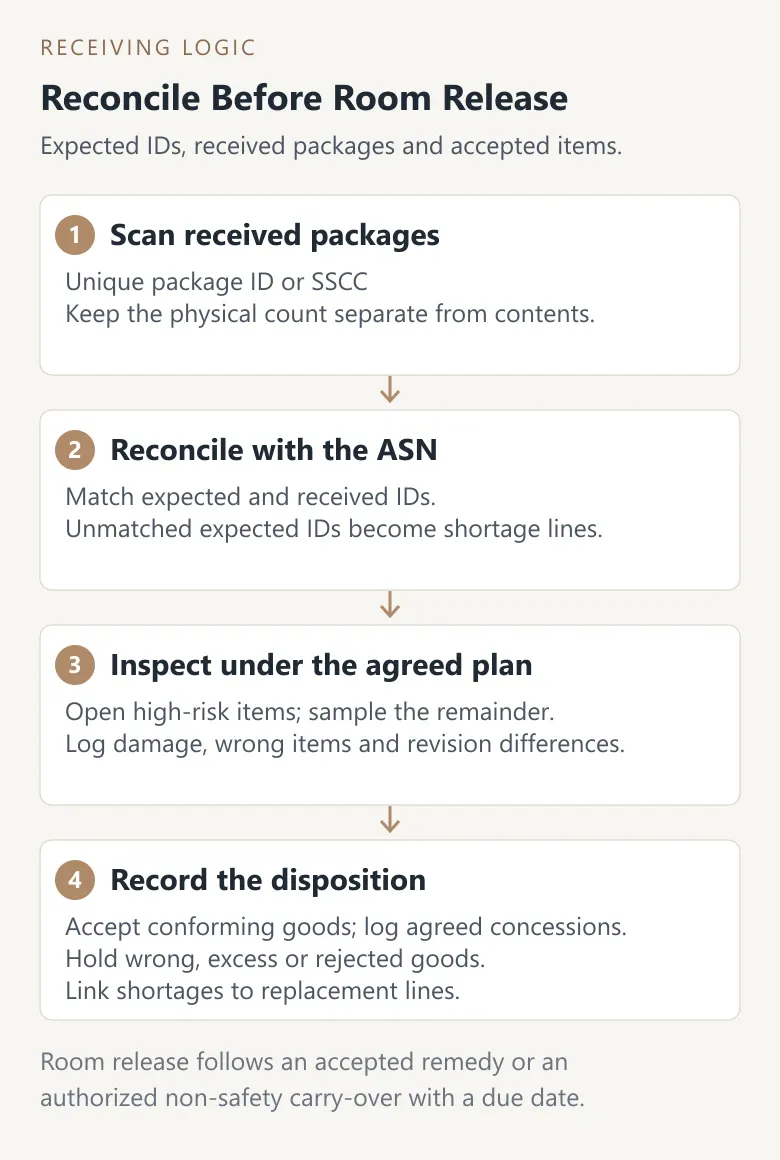
Agree an inspection plan before dispatch, including the receiving lead's authority to quarantine goods and the person authorized to accept a concession. The following is a proposed risk-based plan, not a mandatory sampling standard:
-
Package count — 100%. Scan every package ID or SSCC and compare it with the advance shipping notice (ASN) and the packing list. Record over-shipments as well as shortages.
-
High-risk items — 100% open. Mirrors, glass, stone tops, veneered panels and electrical pieces are checked individually. A cracked mirror inside a sealed crate is still a defect.
-
Remaining items — sampling. Open a stated sample per batch and room type, and increase the sample when the first defects appear. State the sample size, selection method and escalation trigger before receipt. Record the result by item and package; a failed sample puts the affected batch on hold pending the agreed expanded check or corrective action.
Record visible exceptions on the delivery receipt and notify the supplier, carrier and insurer within the applicable contract or policy deadlines. Photograph the label, damage and load position before moving the package where safe; if an unsafe load needs moving first, record why. Keep the packaging until the claim is closed; a damaged piece without its crate is harder to attribute.
| Receiving result | Disposition | Next action |
|---|---|---|
| Correct item, correct quantity, no damage | Accept | Release to the floor or holding area |
| Correct item, cosmetic damage | Accept with note or reject | Photograph, log, agree touch-up or replacement |
| Wrong item or wrong revision | Quarantine | Do not install; notify supplier and hold the room |
| Short shipment | Short-ship record | Create a replacement line with the same revision and finish lot |
| Over-shipment | Hold | Do not install without a written instruction |
Close Shortage and Damage as a Batch Problem
A shortage needs a replacement line with its own batch identity. Keep the claim open until the agreed remedy has arrived and been accepted; a promise to “put it in the next container” does not close it.
Record the shortage against the original package, item and room assignment, then create a replacement batch with the same revision and finish reference. If the finish is a batch-sensitive veneer or fabric, confirm that the replacement comes from the same production lot or is approved as a visible mismatch. A replacement that arrives three shades off is a second defect, not a closure.
Name who pays or authorizes repair, replacement freight, storage and reinspection; keep disputed costs visible. Set a recheck date and a room-release rule: the room cannot be released to operations until the replacement is installed and accepted, or until the authorized project representative and operator accept a documented, non-safety carry-over with an owner and completion date. Safety and applicable compliance defects remain on hold. That is the same closure logic as a mock-up issue, applied to the delivery.
Hand over to Installation
Keep contractual delivery evidence separate from installation and acceptance. For the project's room-readiness register, track three statuses:
-
Delivered. The package is at the property, counted and stored under the project's control.
-
Installed. The piece is in the room, fixed, connected and adjusted.
-
Accepted. The room is clean, protected, photographed and signed off by the operator.
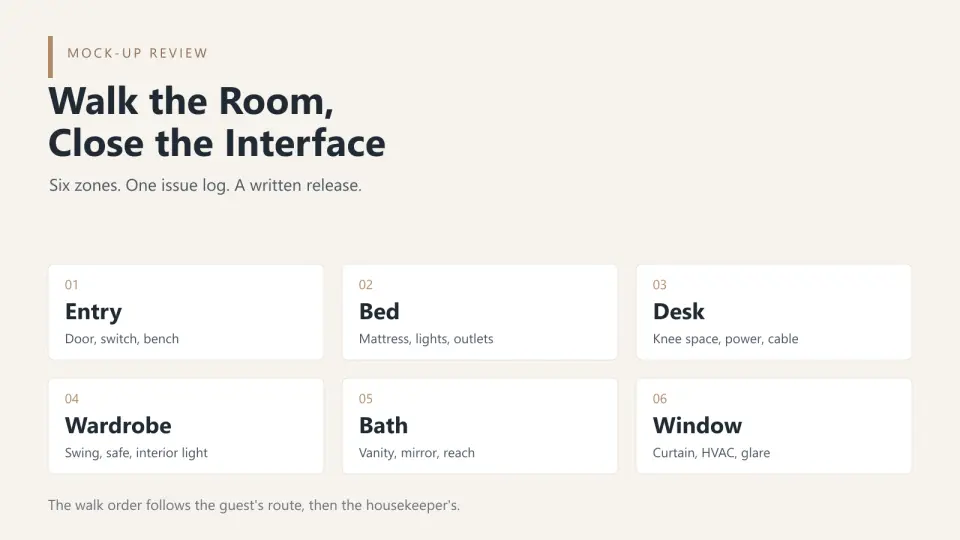
At handover, walk the room against the room-type list: every item present, every fixing complete, every drawer and door operating, every light and outlet working, every surface clean. Remove packaging and protection only when the room is ready for the next trade; a room used as a storage area will be damaged again.
Worked Example: 96 Keys, Three Room Types, Two Batches
A hypothetical property has 96 keys: 60 king, 30 twin and 6 suites. Each suite is one key and two rooms, so the property has 102 physical rooms. The furniture order is split into two production batches: B1 for king and twin, B2 for suites, because the suite detail changed after the mock-up.
| Batch | Room type | Keys | Rooms | Packages | Revision |
|---|---|---|---|---|---|
| B1 | King | 60 | 60 | 180 | B |
| B1 | Twin | 30 | 30 | 120 | B |
| B2 | Suite | 6 | 12 | 48 | C |
For this hypothetical packing plan, each king key uses 3 packages, each twin key 4 and each suite key 8; the package contents are defined on the packing list, not inferred from the room count. The advance shipping notice lists 348 packages (180 + 120 + 48). The receiver scans 345 unique package IDs, leaving 3 expected IDs unmatched. After opening the high-risk packages, the team also finds two king-room headboards with crushed corners.
The three missing packages are assigned to king rooms 318, 320 and 322. They are logged as short-ship lines against B1, not as a general “three short.” The two damaged headboards are quarantined. Order their replacements against the original king-room item ID, revision B and approved finish reference, with new package IDs linked to the claim. A suite item at revision C is not an authorized substitute; any proposed substitution needs a documented technical and design approval before dispatch.
Rooms 318, 320 and 322 (missing packages) and rooms 324 and 326 (damaged headboards) stay off the ready list until the replacement arrives, is scanned against the original item IDs, and is installed and accepted. After the agreed expanded checks establish no wider B1 defect, the other 55 king rooms can proceed.
Send a Delivery Brief with the Order
A supplier can only label and batch what the order defines. Send the room-type matrix, the item IDs and revisions, the package numbering rule, the label fields, the batch definition, the delivery point and the receiving process with the purchase order.
George's Furniture Page starts from a room plan, item list or reference images and quotes the individual pieces. The Hotel Supplies Page keeps furniture separate from operating supplies. A delivery brief through that route should state which items are in each batch, which revision is approved, and who receives at the property; those are project decisions, not something a category page can confirm.
A receiving record should establish what arrived, what is missing, which revision it is, and which rooms can be released. That reconciliation gives the installation team a defensible room-ready list.