Hotel furniture cost per room depends on two definitions: the package included and the denominator used. The numerator is the furniture package plus the costs attached to it. The denominator is the number of keys or physical rooms you divide by. Change either one and the result moves, even when every unit price stays the same.
In the hypothetical project below, the same furniture, at the same illustrative US-dollar prices, produces four defensible answers: $4,556, $5,585 and $6,687 per key, and $6,420 per room. None of them is wrong. Each answers a different question.
That is why a per-room figure should be treated as a definition before it is treated as a benchmark. The useful work happens before the division: decide what is in the package, which costs travel with it, and what the denominator counts.
Separate the Furniture Package from FF&E, OS&E and Construction
Hotel budgets use overlapping labels. A furniture package is a subset of FF&E, but the boundary moves with the contract.
| Layer | Common contents | Usually inside a furniture cost per room? |
|---|---|---|
| Loose furniture | Beds and bases, nightstands, desks, dressers, seating, tables | Often, if the package is defined as loose furniture |
| Upholstered items | Headboards, lounge chairs, sofas, benches | Often, but may be a separate upholstery package |
| Casegoods and fixed joinery | Wardrobes, minibar surrounds, wall panels, reception millwork | Per contract; fixed joinery may sit in construction |
| Mattresses and bedding | Mattress, protector, pillows, linen | Per contract; mattresses are sometimes bought separately |
| Lighting and mirrors | Reading lights, lamps, mirrors, electrical fittings | Per contract; lighting may be FF&E or an electrical package |
| Equipment | TV, safe, minibar, kettle, hairdryer | Usually FF&E equipment, not furniture |
| OS&E | Linen, towels, amenities, tableware, housekeeping supplies | No; separate operating package |
| Construction finishes | Floor, wall, ceiling, built-in services | No; base building or fit-out |
The labels are working categories, not accounting rules. The FF&E and OS&E Checklist shows how the packages divide by room and area; the cost model should follow the same split.
Write the boundary into the first line of the budget: “furniture package: loose furniture, upholstered beds, casegoods and mirrors; excludes mattresses, lighting, installation and OS&E.” A reader can then see what the per-room number does and does not buy.
A renovation adds two lines that a new-build comparison often misses: removal and disposal of the existing furniture, and a credit or deduction for items that are retained. A renovation budget that counts only new pieces can look cheaper than it is, while one that counts removal twice can look more expensive. Mark retained items by room and condition before comparing the per-room result with a new-build figure.
Fix the Denominator: Keys, Rooms and Room Types
A key is commonly used to mean a sellable guest room. A suite may count as one key while containing a bedroom, a living room and sometimes a second bathroom. In the example below, 120 sellable units contain 125 furnished bedroom or living-room spaces. Here, “physical rooms” counts those spaces, excluding bathrooms and circulation; it is an explicit model assumption, not a second industry-standard room count.
Decide which one the budget uses, and state it next to the result. Owners and investors often quote development cost per key; furniture quantities follow the actual item allocation across room types and spaces. Mixing the two creates a small but real distortion before any other assumption is added.
Room-type mix matters more. A hotel is not 120 copies of one room; in this example, a suite costs 2.15 times a king room, so the mix changes the average. Build the furniture quantity and cost by room type, then add the types:
| Room type | Keys | Furniture cost per key (hypothetical) | Extended cost |
|---|---|---|---|
| King | 100 | $4,330 | $433,000 |
| Twin | 15 | $4,480 | $67,200 |
| Suite (one key, two rooms) | 5 | $9,310 | $46,550 |
| Total | 120 | $546,750 |
The king-room figure of $4,330 is the sum of eight cost lines covering nine order units, counting the bed and headboard as one assembly: bed and headboard $1,200; two nightstands at $350 each; desk $600; desk chair $280; lounge chair $450; luggage bench $220; dresser $700; mirror $180. The twin and suite figures follow the same logic with different quantities. These are editorial assumptions, not market prices.
With that subtotal, the room furniture alone is $546,750 ÷ 120 = $4,556 per key, or $546,750 ÷ 125 = $4,374 per room. The difference is only the denominator, and it is already about 4%.
Treat Shared and Public-Area Furniture Explicitly
Lobby seating, restaurant tables, bar stools, meeting-room chairs and outdoor furniture are furniture, but they do not belong to a guest room. A per-key figure can include them, exclude them or allocate them by a stated rule. Each choice answers a different budgeting question.
Three common treatments:
-
Separate budget. Keep public-area furniture as its own line. The guest-room per-key figure stays clean, and the owner sees the total property furniture budget separately.
-
Allocate by key. Divide the public-area total by the number of keys. This is simple and useful for a whole-property benchmark, but it hides the fact that a hotel with a large banquet space carries more public furniture per room.
-
Allocate by area or usage. Distribute the cost by square meters, seating capacity or department. This is more defensible for mixed-use properties, but it needs an area program that may not exist at budget stage.
The Nehmer/HVS cost estimating guide separates guestrooms, public spaces, food and beverage outlets and function spaces, which is a useful reminder that these are different cost categories before they become one per-room number.
In the example, public-area furniture is $126,000. Allocated across 120 keys, it adds $1,050 per key. Excluding it produces a guest-room figure that is not comparable with a whole-property figure.
List the Costs That Change the Landed Total
The furniture price is only one layer. Two quotations can show the same chair price and different landed costs because one stops at the factory gate and the other includes export packing, freight, duty, delivery and installation.
| Cost layer | What to confirm | Why it changes the per-room result |
|---|---|---|
| Product | Unit price, specification, quantity, packing unit | Sets the base |
| Export packing | Carton, crate, foam, edge protection, container loading | Changes damage risk and freight volume |
| Freight and insurance | Port pair, chargeable volume or weight, transit cover | Can be a large share of an imported package |
| Duty, tax and clearance | HS classification, duty rate, VAT or sales tax, broker fees | Depends on destination and product; not a fixed percentage |
| Inland transport and storage | Port to warehouse or site, unloading, storage duration | Adds cost and can add damage |
| Installation | Assembly, wall fixing, electrical connection, touch-up, waste removal | Separate scope unless the contract says otherwise |
| Sample and mock-up | Sample pieces, mock-up room, freight, revisions | A real cost before bulk production |
| Spares and replacements | Extra hardware, fabric, veneer, units | Reduces later downtime but adds to year one |
| Coordination or purchasing fee | Scope of the agent's work, fee basis | May be a percentage or a fixed fee; ask which |
| Contingency | Design changes, damage, shortage, currency | A reserve, not a price |
| Currency and payment | Quote currency, exchange-rate date, payment milestones | Changes the amount actually paid |
Do not apply a blanket percentage to every project. The 5% contingency in the example is an input, not a recommended rate. A published guide may suggest a range for logistics or contingency, but the number that matters is the one built from the project's destination, volume and scope. The Building Materials Quote Comparison shows how to keep these layers visible when two offers are placed side by side.
Build the Model in One Table
A cost model does not need specialist software. It needs one row per item and a consistent set of columns.
| Field | Purpose |
|---|---|
| Item ID and description | Links the cost to the drawing, sample and delivery record |
| Room type or area | Prevents public-area items from being multiplied as guest-room items |
| Quantity per room or area | The multiplication basis |
| Number of rooms or areas | The second multiplication basis |
| Extended quantity | Quantity per room × rooms |
| Unit and pack size | Keeps pieces, pairs and packs from being mixed |
| Unit price | In the quoted currency |
| Extended product cost | Extended quantity × unit price |
| Cost layer | Product, packing, freight, duty, installation, sample, spare or contingency |
| Included or excluded | Shows what the quotation actually covers |
| Source or assumption | Makes the line auditable |
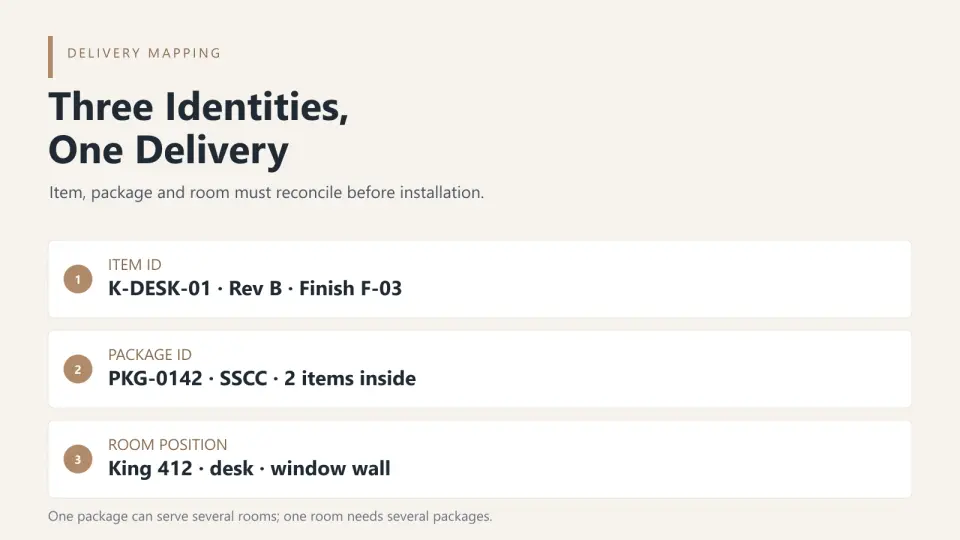
Keep quantity and price separate. A carton price is not a unit price; a pair is not a piece. If a supplier quotes a room set, ask for the set's contents and then allocate each item to its own row.
Worked Example: One Hotel, Four Answers
The hypothetical hotel has 120 keys: 100 king rooms, 15 twin rooms and 5 suites. Each suite counts as one key and two physical rooms, so the property has 125 rooms. All prices are illustrative US dollars. The example covers the furniture pieces listed above plus public-area furniture; it excludes mattresses, lighting, OS&E and construction, so adding any of those would raise the numerator without changing the method.
| Build-up | Amount |
|---|---|
| Room furniture (100 × $4,330 + 15 × $4,480 + 5 × $9,310) | $546,750 |
| Public-area furniture | $126,000 |
| Packing, freight and insurance | $29,500 |
| Duty and clearance | $20,000 |
| Installation, mock-up and spares | $42,000 |
| Subtotal before contingency | $764,250 |
| Contingency at 5% | $38,212.50 |
| Total furniture package | $802,462.50 |
The four reporting views below change the included cost layers or the denominator. For this arithmetic comparison only, the guest-room view retains all $91,500 of ancillary costs ($29,500 + $20,000 + $42,000). It does not estimate the savings from canceling the public-area order. A standalone guest-room budget must reallocate shared freight, duty, installation and mock-up costs by the applicable item or shipment basis.
Calculate the views as follows:
-
Room furniture only: $546,750 ÷ 120 = $4,556 per key; ÷ 125 = $4,374 per room.
-
Guest rooms plus logistics, excluding public areas: ($546,750 + $29,500 + $20,000 + $42,000) × 1.05 = $670,162.50; ÷ 120 = $5,585 per key. This includes packing, freight, duty, installation, mock-up, spares and contingency, but not lobby or restaurant furniture.
-
Full package allocated by key: $802,462.50 ÷ 120 = $6,687 per key.
-
Full package by physical room: $802,462.50 ÷ 125 = $6,420 per room (120 keys, with five suites counted as two rooms each).
The spread from $4,556 to $6,687 is about 47%, produced entirely by definitions. The unit prices, quantities and room count did not change.
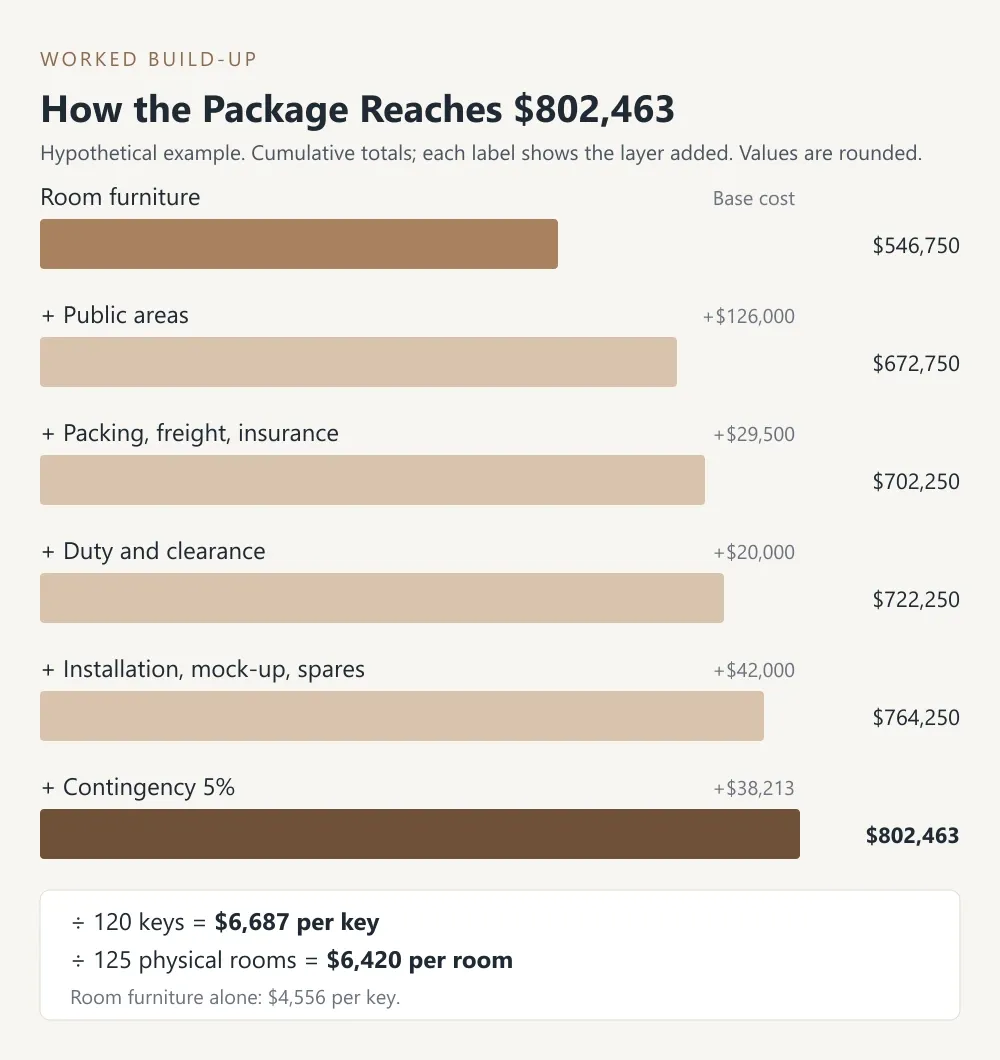
The chart is an editorial model, not a market benchmark. Its purpose is to show which layer each answer includes.
Normalize Two Quotes Before You Compare
Two quotations are comparable only after the same six checks:
-
Same item list and quantities. Compare the same item IDs, room types and counts. A quote that excludes mirrors or mattresses is not cheaper; it is narrower.
-
Same cost layer. Establish whether each price is ex-works, FOB, CIF, delivered duty paid or installed. The Incoterm and named place, or an equivalent written description, must match.
-
Same denominator. State whether the result is per key or per physical room, and whether public areas are included.
-
Same currency and date. Convert at one stated rate and date; keep taxes visible rather than folding them into a unit price.
-
Same sample, spare and contingency treatment. A quote that excludes the mock-up or spares is not equivalent to one that includes them.
-
Same specification. Compare materials, hardware, mattress, lighting and finish, not only the outside dimensions.
If a supplier cannot break the price into these layers, ask for a pro forma with the assumptions written down. If the layers remain opaque, mark the quote as not comparable rather than forcing it into a ranking.
Read Published Benchmarks for Their Scope
Published per-room figures are useful for an order of magnitude, not for a budget line. Their scope is usually different from the reader's.
HVS's 2025 U.S. Hotel Development Cost Survey, based on 2024 project budgets, reports median development cost per room by hotel tier, from roughly $167,000 for limited-service and midscale extended-stay hotels to more than $1,057,000 for luxury hotels. That is total development cost, not furniture, and HVS explicitly cautions that the figures are not a project estimate. It points to construction and FF&E procurement firms for a specific project's costs.
Cost guides can be more granular. The Nehmer/HVS guide separates construction and FF&E costs by hotel tier and by area: guestrooms, guest bathrooms, corridors, public spaces, food and beverage outlets, function spaces and infrastructure. That structure is a useful model for a project budget, but the guide is an estimating reference, not a quotation.
A supplier's per-room range needs the same scrutiny. A casegoods-only figure and a fixed-and-loose-furniture figure describe different packages. Until mattresses, lighting, freight and installation are explicitly included or excluded, neither range establishes a comparable budget.
Use a benchmark to ask better questions: Which tier? Which room type? Which items? Which cost layer? Then replace it with the project's own line-item model.
Present a Range and Test the Sensitivities
A single per-key number invites false precision. Present a base case and explicit alternatives, each with the assumptions that produced it.
In the example, the base case is $6,687 per key. A few changes move it:
| Change | Effect on cost per key |
|---|---|
| Ten king rooms become suites; keys and ancillary costs stay fixed | About +$436 per key |
| Public-area furniture increases 20% | About +$221 per key |
| Packing, freight and insurance increase 25% | About +$65 per key |
| Contingency rises from 5% to 10% | About +$318 per key |
For these selected changes, suite mix and contingency have the largest effects. The ranking also depends on how far each input is varied; it is not a comparison of equal percentage changes. That ranking is project-specific, but the method is not: vary one input at a time, keep the rest fixed, and show the result next to the base case.
For approval, show the $6,687 base case and the $7,006 case with 10% contingency as two allowances for the same scope. List the $5,585 guest-room reporting view separately, with its retained ancillary-cost assumption. A scope exclusion is not a lower-risk estimate for the full package.
Use the range to decide what to negotiate and what to hold as a reserve, not to create an average of unrelated projects.
Send a Package Definition with the Inquiry
A supplier can only price what the inquiry defines. Send the item list with quantities by room type, the room-type counts, the package boundary, the destination, the required delivery phase, the currency, the target date and the approval requirements.
George's Furniture Page starts from a room plan, item list or reference images and asks you to identify the individual pieces for the quotation. The Hotel Supplies Page keeps furniture separate from operating supplies. A useful reply should still state the cost layer, the denominator and the exclusions, because those are what make the per-room figure usable.
A per-room figure is only as good as the definitions behind it. Define the package and the denominator first; the number will then tell you something you can act on.