A hotel furniture package is rarely made by one company. Casegoods, upholstered beds, seating, mattresses, mirrors and fixed joinery may come from different workshops, while a contract supplier, a purchasing agent and a site installer each control a different part of the order.
That is why a shortlist built from company profiles rarely predicts project performance. The useful question is narrower: for each item in this package, which party controls production, which party signs the contract, and what can each one prove? This stops at pre-award fit: a factory audit, a contract review and a destination compliance sign-off remain separate tasks.
Split the Package Before You Compare Companies
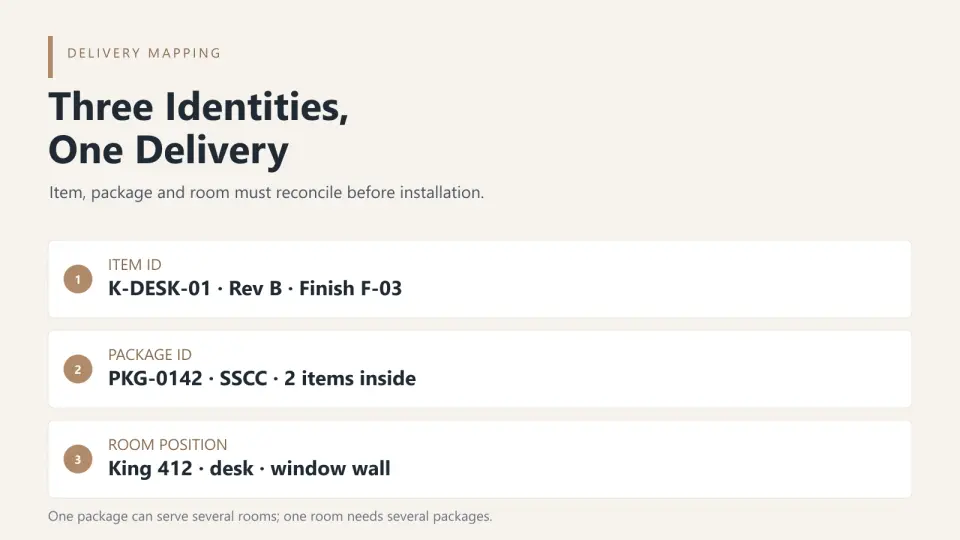
Start with a line list, not a company list. Give every distinct product its own item ID, then record the room types and quantities that use it. A “king room set” can hide a custom headboard, a standard nightstand, a purchased mattress and a locally supplied mirror. Those four items will not follow the same supplier, approval or warranty route.
| Item group | What the package must define | Typical controlling party (confirm per item) |
|---|---|---|
| Loose casegoods | Nightstand, desk, dresser, media unit; dimensions, substrate, veneer, edge, hardware, wall fixing | Casegoods factory, sometimes a contract supplier |
| Upholstered items | Bed and headboard, lounge chair, sofa, bench; frame, foam, fabric, COM/COL, seam and cushion build | Upholstery workshop, which may be separate from the casegoods plant |
| Tables and seating | Dining, coffee and side tables; chair frames, arms, stackability, contract-grade joints | Specialist wood or metal workshops |
| Mattresses and bedding | Size, depth, support, fire performance, delivery compression | Mattress manufacturer, often a separate brand |
| Fixed joinery and millwork | Wardrobe, minibar surround, wall panels; site dimensions, substrate, services | Joinery contractor or millwork shop |
| Lighting and electrical | Reading lights, outlets, USB, switches, drivers | Luminaire or electrical supplier, coordinated with the furniture |
| Outdoor and public-area pieces | UV, moisture, cleaning, heavier use, fixing | Specialist contract or outdoor manufacturer |
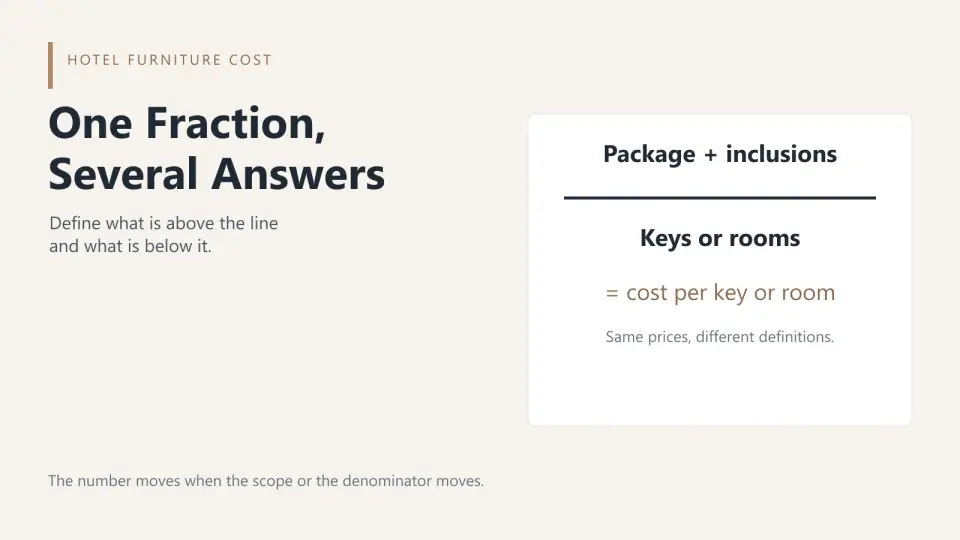
A supplier may quote the whole list and still manufacture only part of it. That is not automatically a problem. The problem is a comparison in which one offer includes a mattress and another excludes it, or one price includes wall fixing and another assumes the contractor will do it.
Write the package boundary into the request for quotation. State which items are in scope, which are supplied by others, which existing pieces are retained, and which site works are excluded. The Room-By-Room FF&E Checklist provides a structure for that list; this article deals with the next step, which is judging who can deliver it.
Identify Which Role Each Company Plays
Four roles appear in most hotel furniture packages, and one company can hold more than one of them. What matters is that the role is written down.
-
Contract supplier. Signs the purchase order, invoices, and usually carries the commercial warranty. It may be a manufacturer, a dealer or a project house that sources from several factories.
-
Manufacturer. Operates the production site and controls the processes that turn drawings and materials into the item. This is the party whose address, equipment and quality records should match the product.
-
Procurement coordinator or FF&E purchasing agent. Places and tracks orders across suppliers, consolidates shipments, and may arrange inspection. Coordination is real work, but it does not make the coordinator the maker.
-
Installer or millwork contractor. Receives, moves, assembles, fixes, connects and adjusts the furniture on site. Installation is a separate scope from supply unless the contract says otherwise.
Ask five questions that separate the roles in practice:
-
Which legal entity will sign the purchase order and issue the warranty?
-
Which factory, at which address, will produce each item group?
-
Who approves shop drawings and the physical sample?
-
Who is responsible for packing, export loading, freight, customs and inland delivery?
-
Who performs assembly, wall fixing, electrical connection and touch-up at the property?
Questions 4 and 5 are developed in the packing, delivery and installation section below; the warranty section covers claims. Keep the same item IDs when you answer them.
Verify the contracting entity against its business registration, purchase order and warranty. Separately identify the manufacturer named on each certificate and the production site it covers. The supplier and manufacturer can legitimately have different legal names; document their relationship instead of requiring one name on every record.
The answers belong in the quotation or an attached responsibility matrix. A company that answers “we will handle everything” without naming the parties has not yet answered the question. The Quote Comparison Worksheet shows how to keep those inclusions visible when offers are compared.
Role separation also changes what happens after a failure. If the contract supplier is not the manufacturer, the warranty claim normally goes to the supplier, while the technical fix depends on the factory. If the supplier changes sourcing mid-project, the approved sample and the production site may no longer match. Recording the parties at the start makes those dependencies visible before they become a dispute.
Verify the Production Site, Not the Headquarters
A headquarters address, a showroom and a factory are three different facts. A company based in the United States or Europe may design and project-manage locally while producing in another country; a trading company may have no production line at all. Neither model is disqualifying, but the buyer needs to know which one is being offered.
Build an item-level production map. For each item group, record the factory name and address, the processes performed there, and the processes subcontracted elsewhere. Common subcontracts include veneering, painting, upholstery, metal frames, stone tops and glass. Then ask who inspects the subcontracted work and who carries the warranty for it.
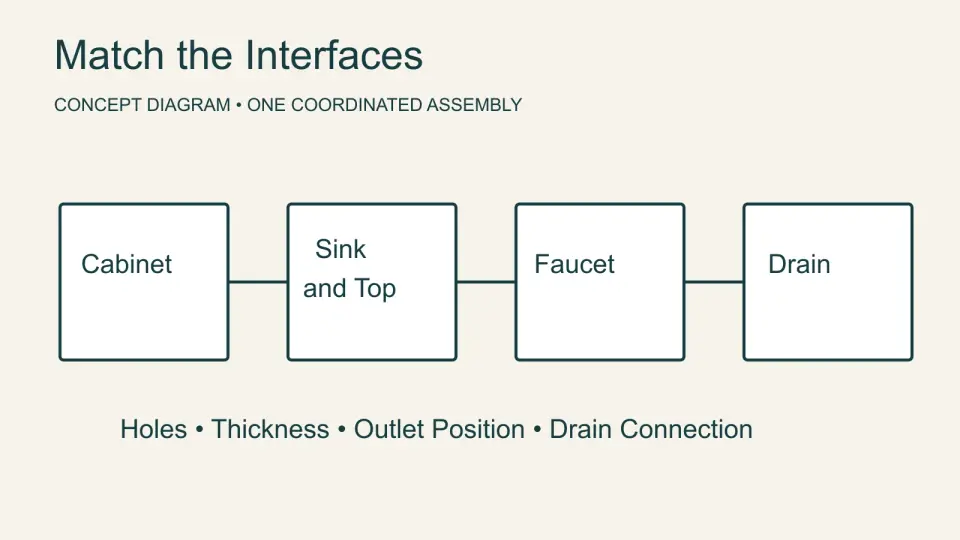
The hypothetical chain below follows one headboard through the stages and parties that touch it. A full package needs the same chain recorded for each item group.
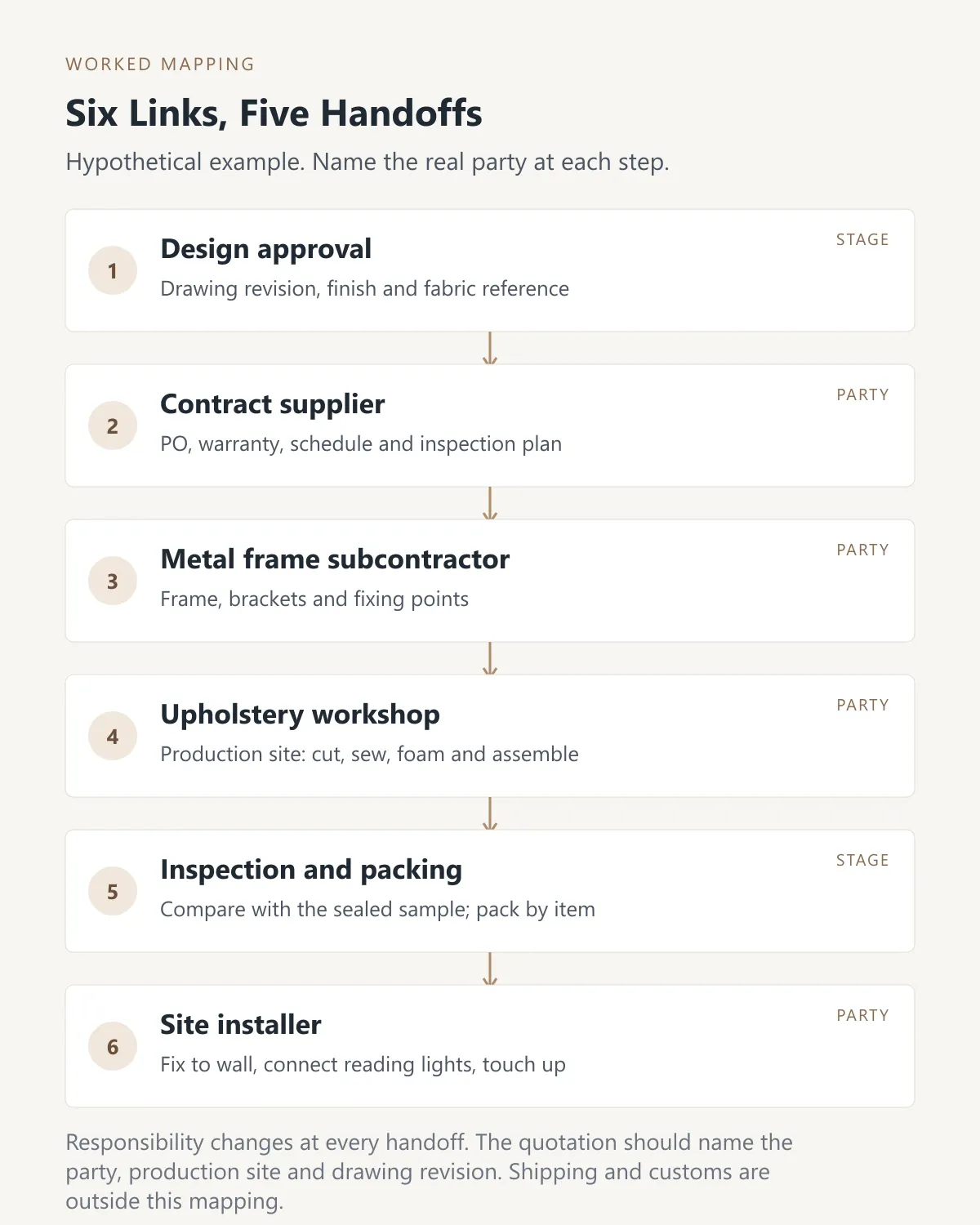
The chain is illustrative, not a recommended supply route. Its value is that it shows where responsibility changes hands and which handoffs need a named owner.
Three checks follow from the chain:
-
Site access. Can the buyer or an appointed inspector visit the actual production site during the run? If not, who inspects, and against what checklist?
-
Process control. If upholstery is outsourced, which workshop selects and cuts the fabric, and who approves the seam and cushion sample?
-
Reorder path. If a chair or finish needs replacement two years later, which factory still holds the drawing and the material reference?
A supplier that will not name a production site before a deposit is a different risk from one that names it under a confidentiality agreement. The first prevents verification; the second only limits disclosure.
Read Certificates at the Level They Cover
Certificates are useful when their scope matches the product, the site and the current version. They are weak when they are treated as a general badge.
Scope, Site and Version
For an ISO 9001 certificate, read four fields: the certified scope, the site or sites covered, the standard edition, and the expiry date. ISO itself does not issue certificates; certification is performed by external bodies, and the status can be checked through the certification body or IAF CertSearch for accredited certification, as described in ISO's Verification Guidance.
The scope statement is where most mismatches appear. “Manufacture of wooden furniture” may cover casegoods but not upholstery. “Design and sale of furniture” may describe a trading business rather than a production site. A scope that names one address does not cover a second workshop, even when both belong to the same group. Read the scope against your item list, not against the company brochure.
Forest certification follows the same logic: it covers a defined product group and chain of custody, not every wood item a company sells.
Product Evidence and Test Reports
The two worked examples here are United States rules. The reading method travels; the rule set does not.
Product-level evidence works differently. In the United States, EPA's TSCA Title VI Rules cover regulated hardwood plywood, medium-density fiberboard, particleboard and finished goods containing them, with applicable labeling and recordkeeping requirements. A certificate for a panel supplier is not the same as lot traceability for the boards used in your casegoods. Ask for the panel specification, the supplier's compliance statement, and the records that connect the delivered batch to those panels.
A second United States example shows the same point. The CPSC Clothing Storage Unit Rule applies to a free-standing furniture item intended for clothing storage when it is at least 27 inches high, weighs at least 30 pounds, and has at least 3.2 cubic feet of enclosed storage volume. Units manufactured after September 1, 2023 are subject to 16 CFR Part 1261. Built-in units intended to be permanently attached, office furniture and some other categories are outside that definition. A guest-room dresser may therefore need a General Certificate of Conformity while a fixed wardrobe may not.
The point is to classify each item, not to apply one certificate to the whole package. For another destination, apply its own scope and thresholds to the same item.
Test reports need the same discipline. Check the sample identity, model or drawing number, test date, laboratory, standard edition and result. Check whether the supplied configuration is the tested item or falls within the report's stated product-family and permitted-variation scope. A similar appearance alone does not establish coverage; changes to the frame, finish, foam or fabric need a documented basis. A fire test report covers a specific construction, foam and fabric combination; an electrical listing covers a product family and its markings. Each one covers only the product, group and site named in it. Flammability, emissions and electrical requirements also depend on the destination and the item's use; ask which rule applies to the specified product rather than accepting “international standard” as an answer.
Ask for Drawings and a Sample That Can Be Approved
Production quality is largely fixed before the first board is cut. The shop drawing is where dimensions, tolerances, materials and interfaces become checkable.
A usable shop drawing shows overall and component dimensions, dimensional tolerances, substrate and veneer direction, edge detail, finish system, hardware model, knock-down fittings, wall-fixing method, and any electrical cutout. For a bed, it also shows the mattress opening and support; for a nightstand, the drawer box, runner and clearance; for a desk, the cable path and modesty panel.
Approval has three separate objects: the drawing revision, the physical finish sample, and the sample piece or mock-up room. Approving a color does not approve a dimension. Approving a drawing does not approve the fabric. Record all three against the item ID and the revision.
A “golden sample” is only a reference if it is sealed, labeled and stored. If the approved sample sits in an open showroom and the factory works from a photograph, the benchmark has already drifted. Ask how the production pieces will be compared with the approved sample, who performs that comparison, and what happens when a piece falls outside the agreed tolerance. Ask who pays for the sample and the mock-up room, and whether that cost is credited against the order.
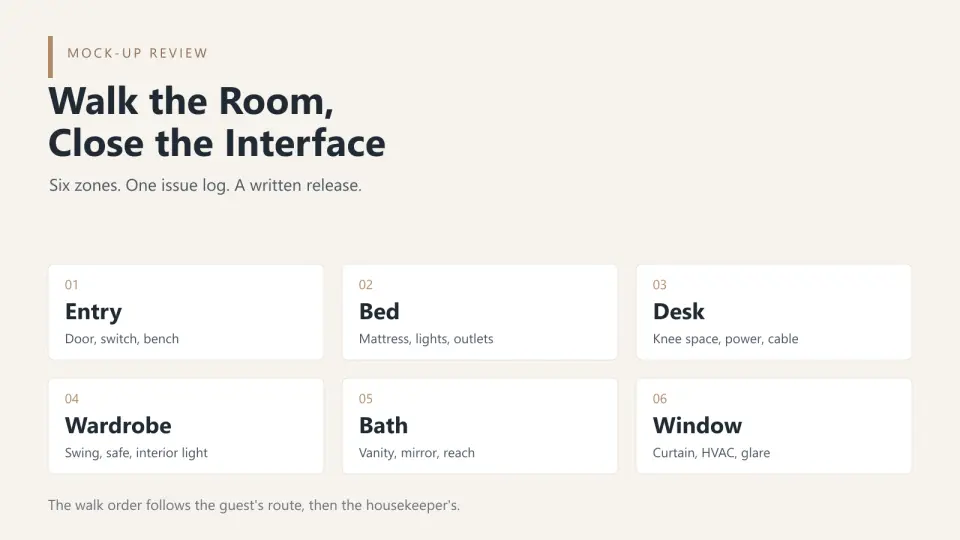
The Cabinet Quality Checklist shows how to connect approved references with in-process and pre-shipment checks; the same logic applies to furniture, with the joinery and upholstery steps added. The Mock-Up Room Review is where those details meet the room.
Test Similar-Project Claims Against Scope
“We have supplied five-star hotels” is a category claim. It does not say what the company made, for which rooms, in which year, or whether it was the manufacturer or a reseller.
Turn the claim into six fields:
| Field | What to ask | Why it matters |
|---|---|---|
| Project and location | Name, city, opening or renovation year | Establishes that the project exists and when |
| Contract role | Manufacturer, contract supplier, agent or installer | Separates production experience from trading experience |
| Item scope | Which furniture groups, custom or catalog | A lobby seating project does not prove casegoods capability |
| Scale | Room count, room types, repetition | Tests whether the factory has run a comparable batch |
| Regulatory context | Destination market and test requirements | A domestic project may not have faced the same import rules |
| Reference | A contactable project or owner representative | Allows verification beyond a logo wall |
A project photograph can illustrate a room, but it does not verify the project or who made the furniture. A logo on a supplier's website is a claim of a relationship, not independent evidence that the relationship existed or that the supplier made the item. Ask for a redacted purchase order, a project schedule, a handover record or a reference contact. If confidentiality prevents disclosure, ask for the project scope and a reference who can confirm it.
Choose references that resemble your project in the dimensions that create risk: the same item type, a similar finish, a comparable quantity, the same destination regulation, and a similar delivery model. One close reference is more useful than ten unrelated logos.
Check Capacity and Subcontracting, Not Just Floor Area
Factory area and employee count are easy to photograph and hard to convert into a delivery date. Capacity should be checked against the actual package.
A practical calculation starts with the number of pieces by process: cutting and edging, veneering, painting, upholstery, assembly, packing. Multiply the piece count by the hours per piece for each process, or divide it by the line rate in pieces per day, then compare the result with the factory's available capacity and its current committed load. The question is not “how big is the factory” but “how many of these pieces can this line finish in the weeks available, alongside the orders already booked?”
Illustrative arithmetic: a 120-room package needs nightstands and desks for each room, or 240 casegood pieces. If the casegoods cutting-and-assembly line can process 30 comparable pieces a day and half its capacity is already committed, the available rate is 15 a day. The 240 casegood pieces then need about 16 working days on that line, excluding the separate finishing, inspection and packing stages. Use process-specific rates when desks and nightstands require different workloads. The 120 headboards follow a different line. These numbers are placeholders for the factory's actual rate; the method is the point. It turns “we can deliver in 60 days” into a statement that can be checked against a start date and a load.
Ask for the current production schedule, the planned start and finish dates for your package, the number of shifts and lines assigned, and the name of the person accountable for the schedule. Ask which processes are subcontracted and how their capacity is reserved. If the answer is a single lead-time number with no start date, the schedule has not been planned.
That logic explains why a short promised lead time can be a warning rather than an advantage. Drawing approval, sample review and material release constrain the production start. Some procurement and production tasks can overlap, but the plan must identify which approvals each stage depends on. A date that ignores the sample stage is not a production plan. The Hotel Furniture Delivery Schedule depends on the same dependencies at the batch level.
Put Packing, Delivery and Installation in the Same Comparison
Two quotations can show the same furniture price and different total costs because they stop at different points. One may end at the factory gate; another may include export packing, freight, customs clearance, delivery to the property, unpacking and installation.
Name the delivery point precisely. “Delivered” is not a location. The quotation should state the Incoterm and the named place, or describe the equivalent responsibilities in plain language. That description should cover export packing, container loading, customs, port and inland charges, unloading at the property, movement to the floor, assembly, fixing and removal of packaging waste.
Packing is part of the technical offer, not an afterthought. Ask for the packing method by item: carton, plywood crate, foam and edge protection, corner blocks, moisture protection, stackability and container loading plan. A cheaper pack that produces damaged corners or crushed veneer shifts cost to the site and can delay the opening.
Knock-down and assembled furniture also change the comparison. Knock-down pieces may save freight volume but require site labor, tools and competent assembly. Assembled pieces reduce site work but consume container space and are harder to move through corridors. The right choice depends on the property's access, labor and schedule, not on a default preference.
Compare Warranty, Spares and Reorder Terms
Warranty is not one number. It is a set of component commitments. A frame, a finish, a foam, a recliner mechanism, an electrical fitting and a mattress rarely carry the same term or the same exclusions.
Ask for the warranty by component and the process for a claim: who inspects, who decides, who pays freight, and whether the remedy is repair, replacement or credit. Ask when the warranty starts — at delivery, at handover or at opening — and how quickly a claim is answered. Ask what voids coverage: cleaning chemicals, humidity, sunlight, improper installation, or use outside the specified environment. A warranty that excludes the destination's normal conditions is not useful coverage.
Spares and reorder terms decide the cost of year three, not just year one. Ask for spare hardware, touch-up materials, an extra length of the specified fabric or veneer, and the minimum order for a replacement piece. Confirm whether the factory will still hold the drawing and the finish reference, and whether a later batch can match the original. A finish match is a batch question, not a color-code question.
Use Pass/Fail Gates Before Any Weighted Score
Use a weighted comparison only after the basic gates have been passed. Otherwise a strong price and a polished presentation can average away a missing production site or an unverifiable certificate.
Set five gates:
-
Legal and production identity. The contracting entity and the production site for each item group are named.
-
Item-level compliance. The required product documents exist for the specified item, market and configuration.
-
Drawing and sample capability. The supplier can produce a checkable shop drawing and a physical sample against a stated revision.
-
Capacity and schedule logic. The production plan fits the package and the required dates, including the sample stage.
-
Delivery and responsibility. Packing, freight, installation and warranty responsibilities are assigned in writing.
A supplier that fails a gate is not rescued by a high score elsewhere. After the gates, a separate set of criteria helps compare the survivors:
-
Technical fit: does the offer match the drawings and the room?
-
Evidence quality: does each claim resolve to a document, a sample or a reference?
-
Capacity and schedule: does the plan survive the sample stage?
-
Commercial terms: what is included at the named delivery point?
-
After-sales support: who holds the drawing and the finish reference in year three?
The weights are a project decision; the evidence behind each score should be traceable to a document, a sample or a reference. Before award, ask for the payment schedule and what each milestone releases.
Send an Inquiry That Can Be Answered
A useful inquiry gives the supplier enough to price the actual package. It needs the item list with quantities by room type, drawings or reference images, and dimensions, materials and finishes. It also needs the destination, the delivery phase, the approval requirements, and the site works you expect the supplier to include or exclude.
George's Furniture Page starts from a room plan, item list or reference images and quotes the individual pieces. The Hotel Supplies Page keeps furniture separate from operating supplies. A response to that inquiry should still identify the production site, the items sourced from others, the sample and approval route, the packing and delivery boundary, and the warranty by component. Those are project-specific answers, not something a category page can establish.
With those answers, you can shortlist suppliers on evidence rather than presentation. The remaining questions — a factory visit, a physical sample, a contract review and the destination's regulatory checks — are specific tasks with named owners. The strongest candidate is not the one with the longest client list. It is the one whose evidence survives an item-by-item check.