Door swing direction describes where the moving panel goes when opened. Door handing is the naming convention used to describe its hinge side and operation. To understand either, start with a named viewing position: which side are you standing on, where are the hinges, and does the panel move toward or away from you?
A bare “left-hand door” can be confusing because different charts use different reference methods. The physical arrangement is easier to describe than its label. Learning that arrangement helps you read floor plans, understand an existing room and make sense of seemingly contradictory guides.
Swing, Handing, Inswing and Outswing
A leaf is the moving door panel. On a typical hinged door, the hinges define the side around which that leaf rotates.
Inswing means opening into a named space, such as a room or building. Outswing means opening out of that same space. For an interior doorway, a door can swing into the bedroom and out of the corridor at the same time.
Push and pull describe your action from where you stand. A bedroom-inswing door is pushed from the corridor and pulled from the bedroom. Those actions change when you change sides; the installed door does not.
Handing attaches names or codes to the arrangement under a particular chart's rules. The chart may use a designated outside side, the push side or another stated observation method. Keep its method and labels together.
A Three-Step Way to Describe Any Hinged Door
1. Name Where You Are Standing
Use room or space names: “in the corridor, facing Room 101.” For an entrance, the named reference might be the exterior side facing into the house.
Some charts call this side outside. On an internal door, outside can mean the corridor or the side outside the room, rather than outdoors. A key side is the side from which a key is inserted; it should not be assumed from the word outside alone.
2. Find the Hinge or Rotation Side
Look at the hinge position, or identify the rotation point if the hinges are concealed. Record left or right from the named viewing side. Handle position alone is a poor substitute, especially on paired doors or doors with decorative pulls.
3. Describe the Movement
Open the panel enough to observe its direction. Does it move toward your position or away from it? Which named space receives the open leaf?
A complete plain-language description might be:
“In the corridor facing Room 101, the hinges are on my left and the leaf opens away from me into the room.”
That sentence describes the physical arrangement without requiring an unexplained LH or RH code.
Four Cases from One Fixed Viewpoint
In all four examples below, the room is at the top and the corridor is at the bottom. The observer stays in the corridor looking into the room.
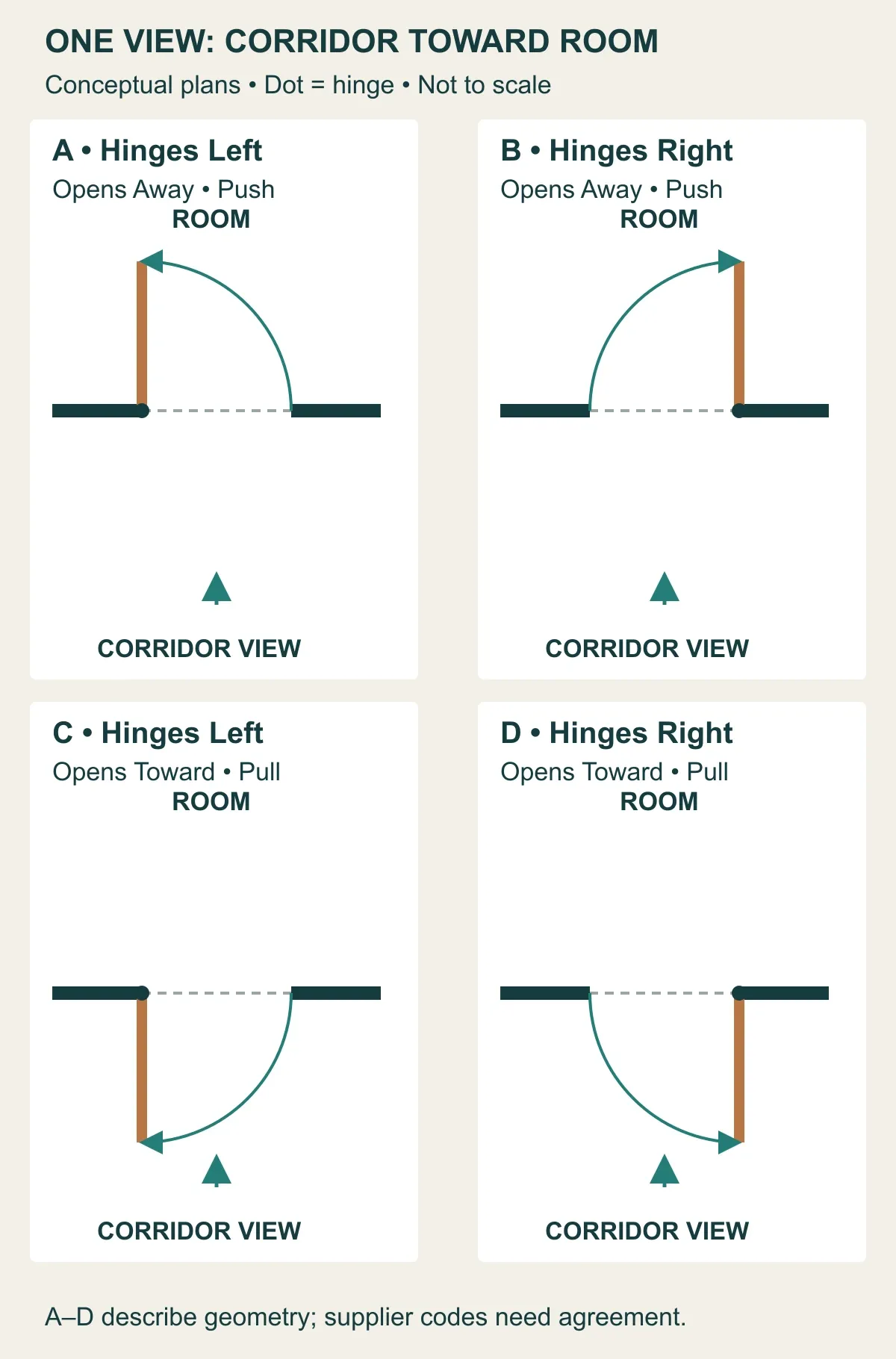
| Case | Hinges From the Corridor | Movement From the Corridor | Space Receiving the Open Leaf |
|---|---|---|---|
| A | Left | Away; push | Room |
| B | Right | Away; push | Room |
| C | Left | Toward; pull | Corridor |
| D | Right | Toward; pull | Corridor |
Changing from A to B moves the hinge side. Changing from A to C keeps the hinge side in that view but reverses the direction of movement. These are different changes, which is why “change it to the other hand” can be ambiguous.
What Happens When You Walk to the Other Side?
Look at Case A from inside the room, facing the corridor. The same physical hinge is now on your right, and the leaf opens toward you. Nothing about the door has changed; your viewpoint has.
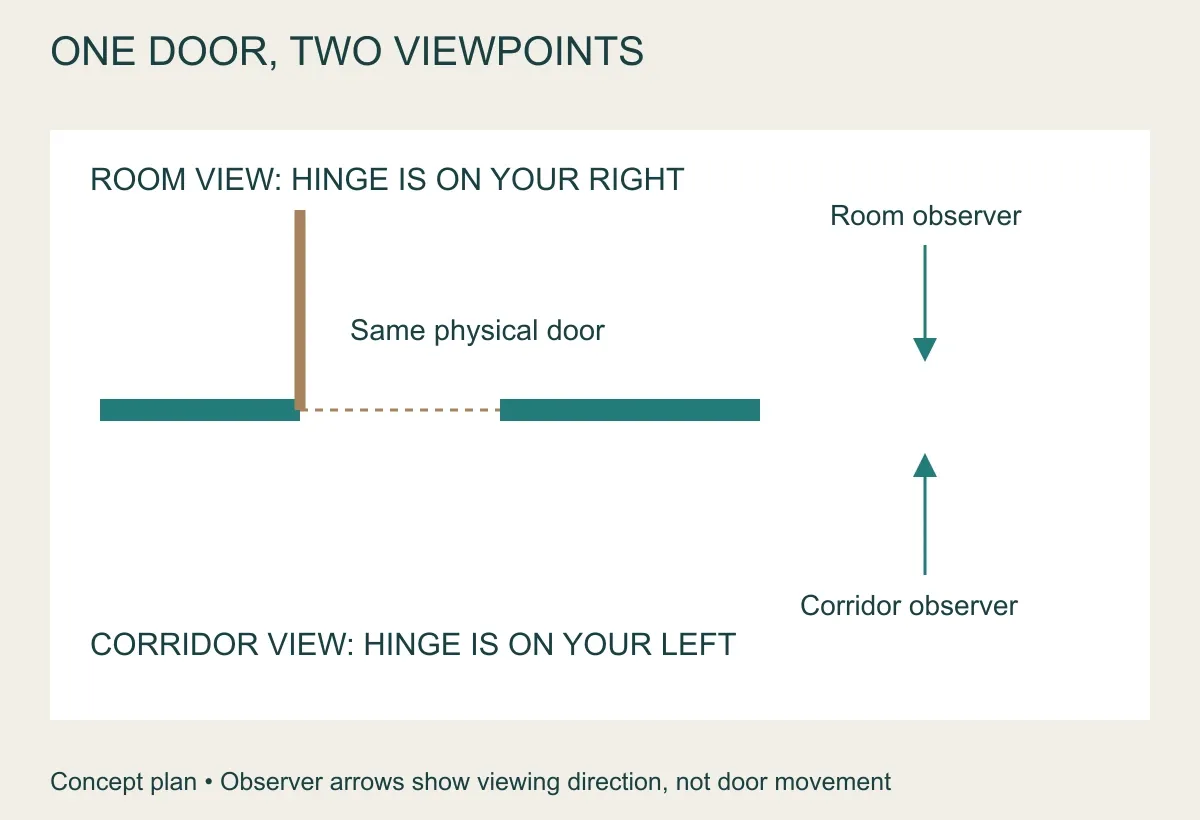
This reversal explains many disagreements between two people describing one door. Before comparing their words, compare where they are standing.
Why Handing Charts Can Give Different Names
One common commercial convention uses LH, RH, LHR and RHR from a designated outside view. The final R means reverse. Another residential naming convention uses left/right combined with inswing/outswing and can label the pull-toward cases differently.
The table illustrates those two conventions with the corridor designated as outside. It is a comparison of chart methods, not a universal translation for every product.
| Physical Case Above | Example Commercial Outside-View Code | Example Residential Swing Name |
|---|---|---|
| A: hinges left, away | LH | Left-hand inswing |
| B: hinges right, away | RH | Right-hand inswing |
| C: hinges left, toward | LHR | Right-hand outswing |
| D: hinges right, toward | RHR | Left-hand outswing |
To understand Case C's residential name, look from inside the room toward the corridor. The hinges appear on your right and you push the leaf out of the room. That view corresponds to right-hand outswing in this residential example. The commercial chart keeps the corridor as its outside reference and calls the same physical arrangement LHR. Therefore, LHR and “left-hand outswing” cannot safely be treated as synonyms without checking the chart.
Push-side and back-to-hinges shortcuts also need their instructions kept intact. Moving to the side where the door can be pushed changes the apparent hinge side for a pull-toward example. A memory aid from one guide should not be combined with a code table from another.
For a real door or fitting, its manufacturer's chart resolves the product's naming system. A sketch plus named spaces and physical movement lets you compare that chart meaningfully. A code without its viewpoint leaves part of the information unstated.
How to Read a Swing on a Floor Plan
A typical hinged-door plan symbol contains three useful features:
-
A line showing the leaf in an open position.
-
A hinge point where that line meets the frame.
-
An arc connecting the leaf's open position to its closed position.
The arc indicates the swept movement. It is not a wall, a dimension line or a promise that the surrounding space is clear. A common symbol shows a quarter-circle sweep, but the drawing's legend—the key to its symbols—and details explain the intended operation.
Find the opening mark next to the symbol, then look up its row in the Door Schedule. The plan can show movement while the schedule supplies dimensions, type and hardware references.
A front elevation, a face-on view of the door, usually does not show the swing as clearly as a plan. For concealed or unusual mechanisms, use the appropriate plan/detail rather than guessing from a photograph of the door face.
Paired Doors: Active and Inactive Leaves
A paired door has two leaves. The active leaf is normally used; the inactive leaf usually remains closed during that use and can be opened when needed. An inactive leaf is not necessarily a permanently fixed panel.
In this hypothetical P-01 arrangement, the observer remains in the corridor. The left leaf is active and opens into the room. The right leaf is inactive and shown closed.
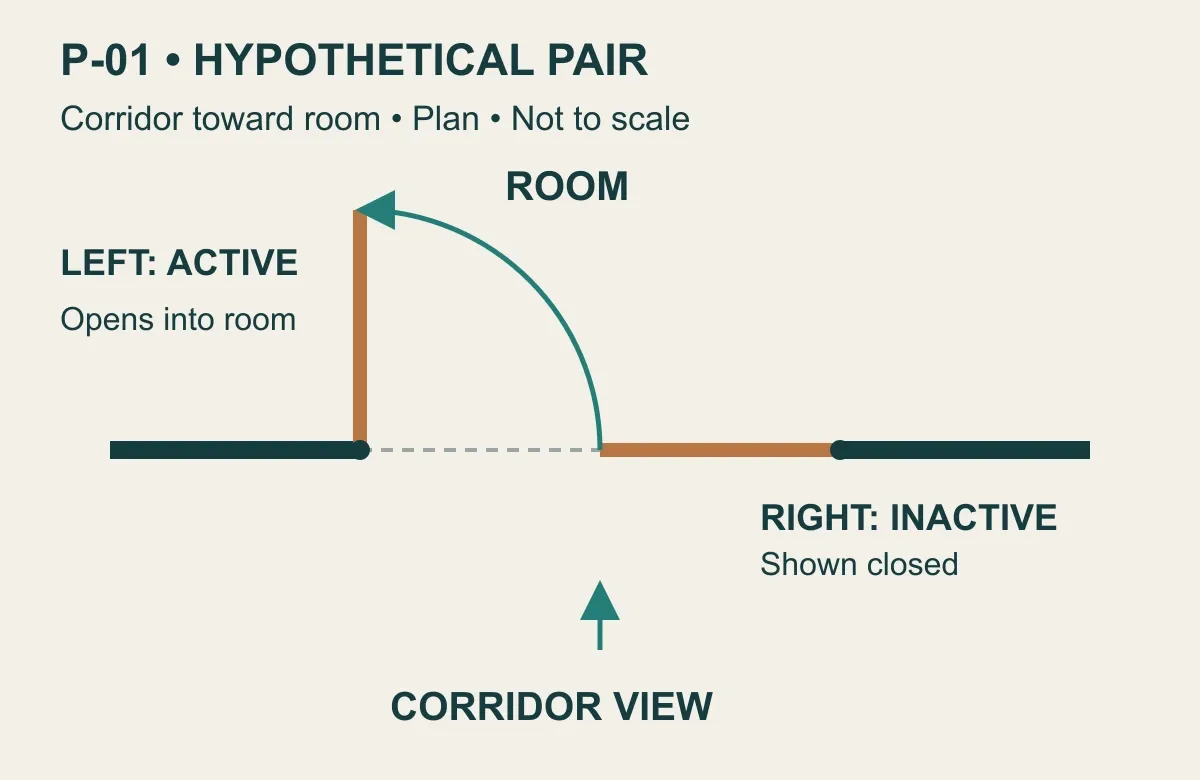
The inactive leaf may be held by bolts or another fitting. Where the leaf edges overlap, the closing sequence can matter. A coordinator is a device used in some paired-door arrangements to control that sequence. The required operation depends on the actual hardware and meeting detail.
A pair can also have both leaves active. It can have unequal widths, with a wider leaf used daily and a narrower leaf opened occasionally. Neither handle appearance nor leaf width alone proves the intended roles.
For understanding passage, ask whether one leaf or both are open. Their combined nominal width does not describe normal-use clear passage. The Door-Size Guide explains that separate measurement.
Double-Acting, Double-Egress and Pivot Doors
These terms describe different mechanisms and arrangements.
| Term | What It Describes |
|---|---|
| Double-acting door | A leaf that can swing in both directions from its closed position |
| Double-egress pair | Two leaves arranged to swing in opposite directions |
| Pivot door | A leaf rotating around a pivot, which may be set in from its edge |
A double-egress pair is not simply a pair in which both leaves swing together into one room. A double-acting leaf is not simply a door viewed from two sides.
On an offset-pivot door, part of the panel moves on the other side of the rotation point. That affects the space it uses and the passage it leaves. Ordinary hinge-side shortcuts may not describe all of its hardware or movement.
These distinctions are more useful than memorizing a fixed number of possible “handings.” Diagrams and actual operating details explain what a particular system does.
How Swing Direction Changes a Room
The panel sweeps through space on one side of the opening. Reversing the swing moves that swept area to the other side; it does not remove it.
| Layout Question | What to Look For |
|---|---|
| Does the panel hit furniture or a fixture? | Cabinets, basins, shelves and objects near the open position |
| Does it overlap another door? | Both arcs and the usable area between them |
| Does it project into a shared route? | The corridor and the passage remaining when open |
| Can someone approach and operate it? | Space around the handle and on both sides |
| Does the handle strike a wall? | Handle projection, stop position and opening angle |
Opening into a room can keep the corridor clear while using room space. Opening out of a tight room can free that internal area while projecting into the space outside. Either choice needs the surrounding layout to be understood.
Exit routes, accessibility and fire-door arrangements can add requirements for a particular building and jurisdiction. A handing chart describes geometry; it cannot determine those requirements or approve the layout by itself.
Reversible Hardware Does Not Mean a Reversible Doorway
Non-handed or reversible hardware can be used or adjusted for more than one handing under that product's instructions. That description applies to the item, not automatically to the complete door.
A reversible latch does not relocate hinge cutouts or mounting holes in the frame. A lever that can be reversed does not reverse a threshold, a seal arrangement or the rest of an exterior assembly.
Changing an existing door's operation may therefore involve the frame, prepared holes, stops, hardware and surrounding layout. Understanding which part is reversible prevents one flexible component from being mistaken for a flexible whole.
Common Questions
Does Left-Handedness Refer to the Person Using the Door?
No. It describes the door or hardware under a naming convention. It does not require the user to favor their left hand.
Are Reverse and Outswing the Same Thing?
They can describe related arrangements within a particular chart, but they are not interchangeable labels across every convention. First identify the designated outside side, then compare the physical hinge and movement.
Must Every Door Swing Outward?
No. Swing depends on the layout, use and applicable requirements. The presence of an exit route can matter, but a universal instruction for every residential and commercial door would be misleading.
Can a Photograph Establish Handing?
It may show hinge position and some movement, but can hide the reference side, mechanism or paired-leaf roles. A labeled plan or physical observation provides the missing context.
To describe a door clearly, keep four facts together: the viewing side, the hinge or rotation side, the receiving space and the leaf arrangement. Those facts remain useful even when chart terminology changes.