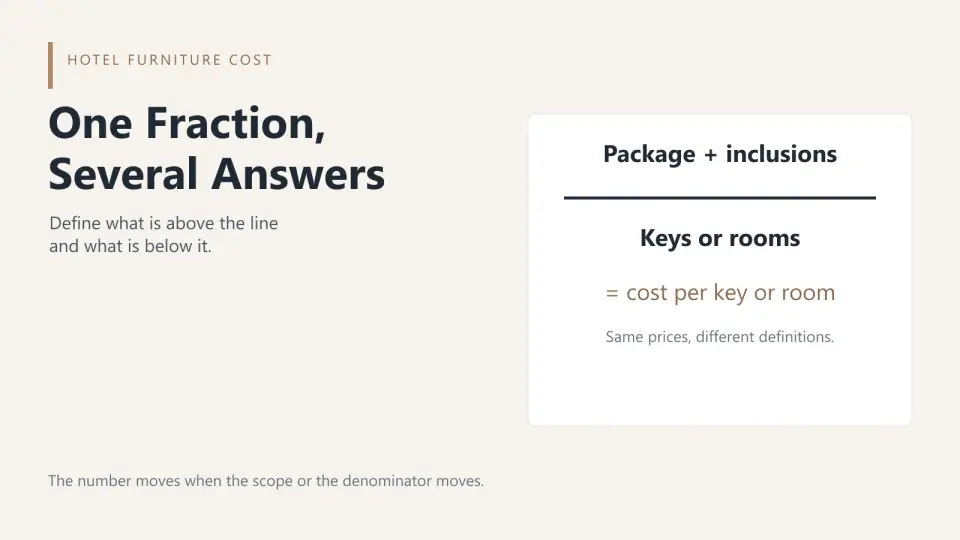
A building materials quote comparison should show what you will receive and what you still need to pay for. Two different totals are not useful evidence of a saving until the products, quantities, and delivery arrangements match.
The template below is for buyers comparing written supplier offers. You can copy the tables into a spreadsheet or project record. It keeps product differences, additional costs, and unanswered questions visible instead of hiding them inside one total.
Define the Purchase You Want Both Suppliers to Price
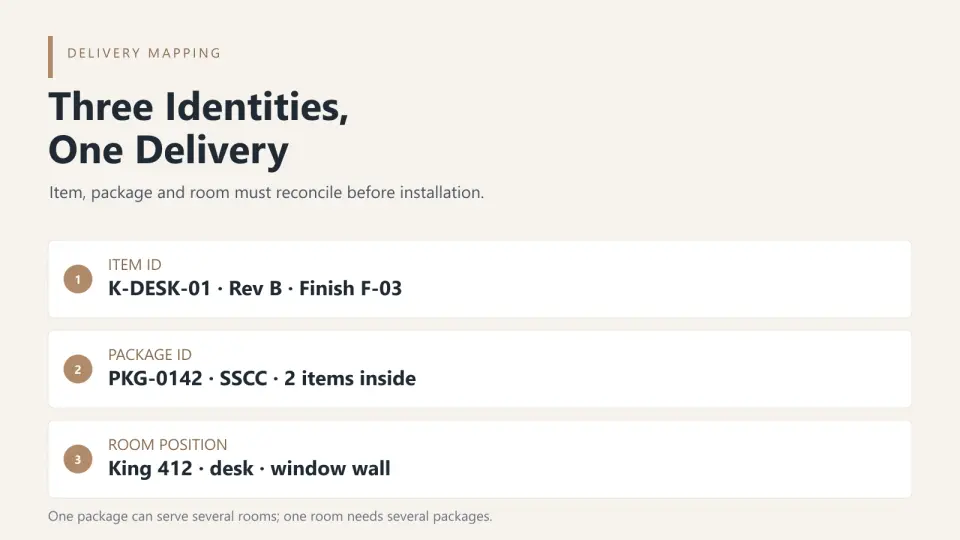
Write the specification you want both suppliers to price for each item. Include the item reference, quantity and unit, drawing revision, material, finish, required accessories, and delivery destination.
Then mark where an offer differs. A different cabinet substrate or missing countertop is a scope change. A different hinge model may require technical approval. Neither difference can be resolved simply by adding a guessed price.
Ask the seller for a revised offer that meets the requirement, or keep the alternative in a separate comparison. If the product does not meet a required performance or installation condition, a price adjustment cannot make it suitable.
Check Units, Quantities, and Currency
Convert offers to the same purchasing unit. For tile, for example, establish the declared coverage per carton before comparing a carton price with a price per square meter. Use the number of whole cartons you must actually order, rather than pricing a fraction you cannot buy.
Also distinguish the measured area from the order quantity. Any allowance for cuts, breakage, or spares needs a stated basis agreed for the project; do not quietly apply different allowances to each supplier.
Use one comparison currency and the same conversion date, applying the appropriate exchange rate to each original currency. Keep the original currency and amount as well. A planning conversion is not a promise of the exchange rate or bank charges that will apply when you pay.
Copy This Quote Comparison Template
Create a separate record for each item or clearly defined package. Keep the seller’s quote reference and revision with the record so a later change can be traced.
Start each record with the basis both offers will be measured against:
-
Item and quantity: __
-
Required specification and drawing revision: __
-
Required accessories: __
-
Comparison currency: __
-
Delivery destination and unloading scope: __
| Comparison field | Supplier A | Supplier B |
|---|---|---|
| Seller, quote reference, date, and validity | Enter details | Enter details |
| Item reference, quantity, and purchasing unit | Enter details | Enter details |
| Drawing revision and product specification | Matches / list differences | Matches / list differences |
| Included accessories and required extras | List each item and whether its cost is included, additional, or unknown | List each item and whether its cost is included, additional, or unknown |
| Goods price and original currency | Enter amount and currency | Enter amount and currency |
| Comparison currency and conversion | Applicable exchange rate and date, if needed | Applicable exchange rate and date, if needed |
| Packing and delivery destination | Describe what is included | Describe what is included |
| Additional costs to the same destination | List separately | List separately |
| Payment, production timing, and warranty terms | Record conditions | Record conditions |
| Subtotal of quoted costs to the stated destination | Enter subtotal; identify included lines | Enter subtotal; identify included lines |
| Estimated additions | Amount, source, date, assumptions | Amount, source, date, assumptions |
| Required costs still unconfirmed | List costs and the contact resolving them | List costs and the contact resolving them |
| Planning budget status | Complete / incomplete; explain limits | Complete / incomplete; explain limits |
| Open questions and required revisions | List the question and who will answer it | List the question and who will answer it |
For a quote received during a visit, retain the model, finish or fabric code, and showroom contact with these details. The Foshan Furniture Buying Guide explains what to record before leaving the showroom.
Label Costs Before Adding Them
Use clear labels in the worksheet:
-
Included: covered by a price already entered elsewhere in the worksheet. Note the relevant line.
-
Additional quoted cost: separately priced and needed for the common requirement.
-
Estimate: a planning amount with its source, date, and assumptions.
-
Unconfirmed: the amount or responsibility is still unknown.
-
Not required: outside the agreed purchase, with the reason recorded.
For each extra cost, keep the amount and status in separate fields: for example, “Amount: $300; status: additional quoted cost” or “Amount: unknown; status: unconfirmed.” Record the source and date beside an estimate.
“Included” is not a second charge. If export packing is already in the goods price, record that fact rather than adding a packing estimate again.
“Excluded” needs a follow-up question. The buyer may still need to arrange and pay for that work. An unquoted delivery charge belongs under “Unconfirmed,” not “Not required.”
Keep a subtotal of quoted costs separate from a budget that contains estimates. If an important item remains unconfirmed, label the comparison incomplete. A blank cell should never quietly become a zero.
Worked Example: Which Vanity Offer Is Lower?
The following figures are fictional and illustrate the method only. They are not George prices, market averages, or an actual project. All amounts are in U.S. dollars.
Assume the buyer needs 24 identical vanity cabinets. Both suppliers can meet the same approved cabinet drawing, material, finish, and hardware requirement. A lists the required hardware separately; B includes it in the cabinet price. The comparison ends at the same named collection warehouse in Foshan. The cabinets exclude countertops, basins, and faucets in both offers.
Supplier A prices the cabinets at $250 each, or $6,000. Supplier B prices them at $270 each, or $6,480. At first glance, A is $480 lower.
The required hardware, packing, and collection arrangements change that comparison. In this example, all the additions below have been quoted for the stated quantities and destination.
| Cost to the collection warehouse | Supplier A | Supplier B |
|---|---|---|
| 24 cabinet units | $6,000 | $6,480 |
| Required hardware | $240 additional | Included in cabinet price |
| Export packing | $300 additional | Included in cabinet price |
| Collection and delivery to the same warehouse | $200 additional | $180 additional |
| Comparable subtotal | $6,740 | $6,660 |
A’s subtotal is $6,000 + $240 + $300 + $200 = $6,740. B’s subtotal is $6,480 + $180 = $6,660. B is therefore $80 lower for this defined purchase, even though its initial cabinet price was higher.
That is a comparison to the warehouse, not the final cost at the building. Export clearance, international freight, insurance, import charges, destination handling, local delivery, and installation are outside this example.
If A’s packing charge were still unknown, the worksheet would show a subtotal of quoted costs of $6,440 plus unconfirmed packing. It would not justify a final price ranking.
Extend the Budget to Your Actual Destination
Choose where the next cost comparison ends: arrival at a port, delivery to a warehouse, or receipt at the job site. Name the location and specify whether unloading is included.
For imported goods, a budget may need the following additional lines. Add only costs that apply and are not already included elsewhere.
| Possible cost | Information needed before entering an amount |
|---|---|
| Inspection or additional testing | Agreed scope, provider, and fee. |
| Collection, consolidation, and storage | Pickup locations, completion dates, storage terms, and whether those services are already included in another price. |
| Export clearance and origin handling | Who arranges the work and which charges are covered. |
| International freight and insurance | Actual cargo details, route, coverage, quote date, and validity. |
| Duties, taxes, and brokerage | Product and destination review by the responsible customs professional. |
| Destination handling and local transport | Named destination, access conditions, and included services. |
| Unloading and installation | Required equipment, labor, and the party quoting each task. |
Record costs shared by several items, such as one shipment’s freight or consolidation fee, once at shipment level. If you allocate them to item records, document the allocation basis and check that the allocated amounts add up to the shipment total. Do not add the full shipment charge again.
Use the same cargo information when requesting freight estimates. Different packing dimensions or weights can change the result, so an early estimate based on an incomplete product list should remain labeled as such.
A seller’s delivery term helps identify which tasks, costs, and risks it accepts. Record the full agreed term, named place or port, and version where applicable. Do not assume that a price described as “CIF,” “DDP,” or simply “delivered” contains every cost in your project budget.
The Importing Checklist explains the wider delivery and approval questions. This worksheet organizes the answers; it does not determine a product’s tariff rate or replace an actual freight quotation.
Compare the Conditions That the Total Does Not Show
If an offer says “ready in six weeks,” ask when the six weeks begin: after the deposit, final drawings, sample approval, or another event.
Keep payment milestones alongside inspection and shipment approval. Make sure the agreed sequence allows required checks to happen before the next commitment.
Read the warranty and remedy as well: what is covered, who reviews a claim, and who pays replacement freight and local labor? A replacement part has limited value if nobody has considered how it reaches the site or who installs it.
Record these differences alongside the prices. Do not hide them in an arbitrary numerical quality score or assume that an $80 price difference outweighs them.
Send Back Specific Questions
Use the worksheet to request a revised, comparable offer. For example:
Please revise item V-01 to match drawing revision C, including the specified hardware and export packing. Show delivery to the named collection warehouse separately, and confirm the quote validity and production-start conditions.
Replace those references with the actual project information. A precise question gives the seller something it can answer; “Is everything included?” usually leaves too much unstated.
When all required products and costs have a clear status, review the scope, budget, and remaining conditions together. Keep the agreed quotation and any revisions with the order.
George’s Project Sourcing Services describe the support available for coordinating an order. When you Request a Building Materials Quote, include the material list or drawings, approximate quantities, destination, and target dates. Separate items still being priced from specifications already confirmed.