Thermofoil usually describes a decorative film formed over a cabinet door or panel. “Laminate” can describe several different surface systems. Before comparing thermofoil and laminate cabinets, identify which laminate is being offered and how the finished component is made.
The most useful comparison includes the substrate—the supporting panel beneath the surface—along with the door shape (profile), face, edges and back. Those details explain what the sample represents and which care, installation and replacement questions remain open.
Define the Surface Terms First
Thermofoil is not metal foil. In common cabinet use, it is a thermoplastic decorative film formed over a supporting panel, often MDF. The film can follow a shaped door face and continue around its edges.
Thermofoil belongs to the broader group of formed-film laminates. Three-dimensional laminate, or 3DL, describes thermoplastic film formed over a shaped component. In this guide, the “thermofoil / formed film” column covers that group. Identify the specific film product and forming system rather than relying on the category label.
High-pressure laminate, or HPL, is made from layers of paper and resin before being bonded to a supporting panel. Thermally fused laminate, or TFL, uses resin-treated decorative paper fused directly to the panel; it is often described as melamine.
HPL, TFL and 3DL are different systems. “Three-dimensional” does not mean “high-pressure,” and TFL is not another name for every film laminated onto a flat surface.
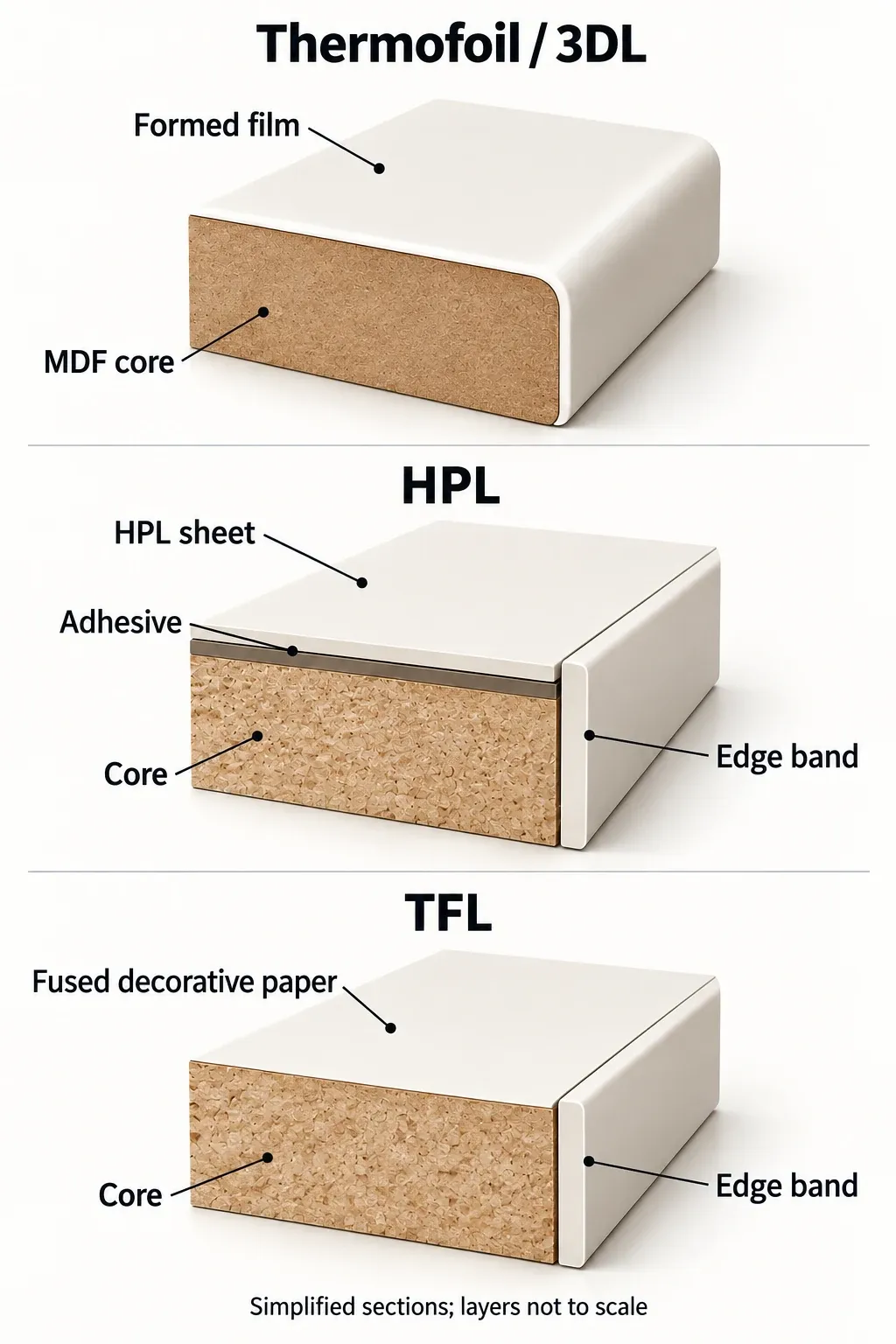
| Detail | Thermofoil / formed film | HPL | TFL / melamine-faced panel |
|---|---|---|---|
| Surface formation | Film formed over a supporting component | Separately made laminate bonded to a substrate | Decorative paper fused directly to the panel |
| Edge question | How the film wraps around and where it ends | How the edge is finished; whether a suitable laminate is formed around an edge (postformed) | Which strip (edge band) covers the cut panel edge |
| Back question | Which material covers the back and meets the film | Which backing or finish is specified | Which finish is specified on the opposite face |
This table describes construction, not a performance ranking. The Cabinet Material Guide explains how the surface and underlying panel fit into the complete cabinet.
Compare the Actual Door Profile and Edges
A flat material swatch can show color, texture and sheen. It cannot show how the finish looks around a shaped recess, corner or door edge.
For a thermofoil option, review a sample in the intended profile where available. Look at the transition from the face to the edges and the point where the film meets the back. A continuous-looking face does not mean the entire component has no joints or exposed transitions.
For an HPL or TFL option, review the edge treatment with the face. Check whether the edge is intended to match, contrast with or remain visible against the main surface. If the quote uses the word “seamless,” establish which joint or surface that description refers to.
Some HPL grades can be postformed around curved edges. That is a specified material and fabrication process, not evidence that any HPL sheet can wrap any shape machined into a door. Likewise, do not assume every thermofoil product supports every profile.
Ask for a drawing or representative sample when the profile is central to the design. A picture of a different door style is useful inspiration, but it does not show how the proposed edge will be constructed.
The Supporting Panel Still Matters
Two white doors can have different substrates and edge details even when the finish labels sound similar. Record the core material, thickness, door construction and hardware preparation separately from the decorative surface.
A smooth face does not prove the substrate's moisture resistance or fastening performance. The MDF and Plywood Comparison explains which panel details belong in that part of the decision.
For the complete kitchen, identify where the selected finish is used: fronts, visible ends, fillers, shelves or interiors. Surfaces with matching colors may still differ in texture or sheen when different surface systems are used. Review them together where they meet.
Review Heat, Moisture and Cleaning Conditions
Formed thermoplastic films can be sensitive to excessive heat. The substrate, adhesive, film and component construction all belong in the assessment. Using HPL or TFL does not remove the need to account for appliance heat or steam.
Before approving the layout, review:
-
The selected door or finish manufacturer's care and use instructions.
-
Appliance clearances and ventilation instructions.
-
Areas exposed to steam, including small appliances beneath wall cabinets.
-
How edges, backs and any site-made cuts are protected.
-
Whether the proposed cleaning products are permitted for the exact surface.
Do not transfer a temperature limit or clearance from a different product. If a heat shield or another protective detail is proposed, the responsible parties should check it against both the cabinet and appliance instructions.
Cleaning advice can also vary within a finish family. A manufacturer may specify a soft cloth and mild soap while excluding abrasives or particular solvents. Keep the actual care sheet with the handover documents rather than relying on a generic “easy to clean” promise.
A water-resistant face is not a waterproof cabinet. Review the complete component, including the panel behind the face and the places where water could reach it.
Plan for Damage and Replacement Before Ordering
A chip in an edge band, a damaged face and a lifted film are different issues. Do not assume that all can be repaired in place or that one treatment works across finishes.
Establish how the supplier handles each type of damage for the selected product. The response might involve a repair method, a replacement front or another agreed action. Obtain the approved method before applying glue, heat, paint or a cleaning chemical to a damaged piece.
For replacement parts, retain the cabinet reference, front dimensions, profile, surface code, sheen, grain direction and hardware preparation. A color name alone may not identify a matching replacement. Ask whether the proposed finish has a matching edge product and how any future variation will be handled; do not assume an indefinite supply of identical replacements.
Approve a Complete Finish Specification
Use the following fields to turn a visual preference into an order description:
-
Cabinet reference and component.
-
Substrate and component construction.
-
Identified surface system and product code.
-
Door profile, edge treatment and back finish.
-
Color, texture, sheen and grain direction.
-
Sample reference and scope of sample approval.
-
Applicable care instructions and agreed procedure for reporting and resolving damage.
For an illustrative comparison, one quote might offer a formed film on a profiled MDF door while another offers HPL on a flat panel. Even with similar colors, they are different finished products. Decide whether the flat profile is acceptable before treating the second quote as an equivalent price alternative.
Thermofoil may be worth evaluating for a continuous-looking finish over a shaped front. HPL or TFL may be worth evaluating when a specified panel-and-edge construction suits the design. Select from the actual products and their supporting information rather than assuming one finish type is always best.
Use the Specification Approval Checklist to keep appearance and technical decisions distinct. The Cabinetry and Wardrobe Page explains the project information to prepare for an inquiry.