When comparing MDF and plywood cabinets, first identify the component you are specifying. MDF's smooth, grain-free surface is useful for painted fronts and routed profiles—shapes machined into the panel. Plywood is used for boxes, shelves and other cabinet parts. A kitchen can use both.
Neither name is a complete specification. The panel product, thickness, finish, joints and hardware determine what you are actually ordering. Compare those details for the same component before deciding whether one quotation is a better fit.
What Is the Difference?
Medium-density fiberboard, or MDF, is made from wood fibers combined with a binder and pressed into a panel. Plywood uses bonded wood layers, generally arranged with grain directions alternating between layers.
The core is the material inside the panel, beneath its outer faces. Some panels combine inner layers of veneer—thin real-wood sheets—with MDF layers near the surface. A decorative wood face can cover different core constructions.
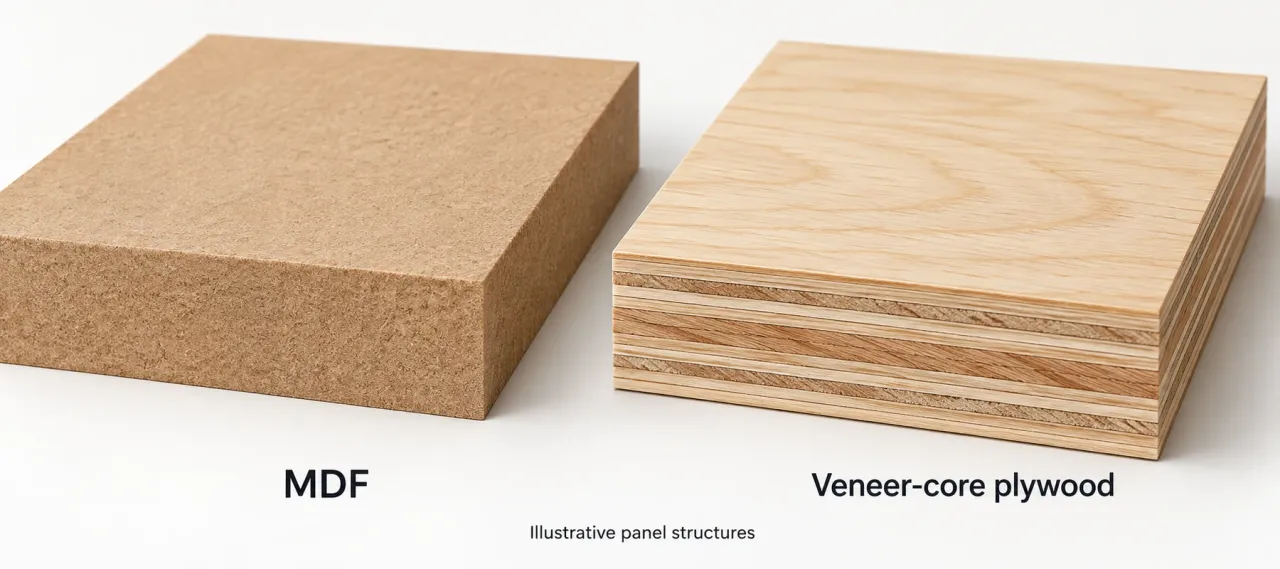
| Comparison | MDF | Plywood |
|---|---|---|
| Basic structure | Wood fibers and binder pressed into a panel | Bonded wood layers; some products use combination cores |
| Surface and machining | Uniform, grain-free surface suited to painting and shaped profiles | Face veneer and core affect the surface and machining result |
| Cabinet uses to evaluate | Painted doors, drawer fronts, boxes, panels and other specified components | Boxes, shelves, panels and other specified components |
| Information the name leaves out | Grade, thickness, exposure conditions, fastening and finish | Core, face grade, thickness, exposure conditions, fastening and finish |
This is a comparison of material types, not a strength or quality rating. For a full breakdown of the box, back, shelves and fronts, use the Cabinet Component Guide.
Compare Boxes and Doors Separately
Cabinet Boxes
Specify the panel material and joints for the cabinet box. Identify the sides, bottom, top construction and back separately. The back may be different from the side panels, so the label “plywood box” does not establish the back’s material or thickness.
For either material, review how the box is joined and how shelves and hardware attach. A panel substitution may require changes to those details. Keeping the visible doors the same does not make the substituted box equivalent.
Painted Doors and Drawer Fronts
MDF is worth evaluating when the design calls for a smooth painted surface or a routed profile. Its uniform structure provides a useful starting point for that work.
Door construction still needs to be identified. A one-piece routed front has its shape machined into one panel. A frame-and-panel door has a surrounding frame and a separate center panel. The two constructions differ even if painted the same color. Record the actual construction, finished dimensions, edges and back treatment.
For a door made from plywood, specify the panel core, face veneer and edge finish. If a painted result is required, review a finished sample made using the proposed construction. A photograph of a different door cannot show whether the selected panel will produce the intended surface.
Shelves and Drawer Parts
Shelves must be considered with their clear span—the unsupported distance between supports—and intended contents. Panel thickness alone does not establish an allowable load. Compare the actual shelf arrangement rather than assuming a material name settles the question.
For drawers, separate the sides from the bottom and identify how the bottom is supported. Then match the drawer to its slides and intended use. A slide rating does not establish the capacity of an unspecified drawer bottom.
Moisture Resistance Needs a Defined Product
Moisture-resistant MDF exists, but “moisture resistant” does not mean “waterproof.” For example, a manufacturer may approve a particular moisture-resistant (MR) board for humid indoor conditions while requiring full sealing and coating and specifying that the board must not get wet. That approval applies only to the specified product under the manufacturer's stated conditions.
Plywood also needs a defined product and exposure classification. Do not infer that a plywood cabinet can tolerate leaks or standing water because it is used in a kitchen.
Around sinks and dishwashers, include these details in the review:
-
The proposed panel and the conditions its manufacturer permits.
-
How faces, backs and exposed edges are finished.
-
How plumbing holes and other cut edges are treated, including cuts made on site.
-
The appliance installation requirements and responsibility for completing the cabinet work.
Some moisture-resistant boards use green dye for identification; the dye does not create their moisture resistance. Neither that color nor a water-resistant decorative face establishes how the panel performs under the intended moisture conditions. Keep the product documentation with the order, and follow the selected panel and finish instructions.
Match the Fasteners to the Panel and Hardware
Hinges, drawer slides and cabinet joints depend on attachment details. Fastening into a panel face differs from fastening into an edge.
For each panel under consideration, compare the proposed fasteners and the preparation needed to install them: where the fastener goes, how it is installed and whether the hardware manufacturer supports that arrangement. A broad claim that one material “holds screws better” leaves out those conditions.
If a quoted panel changes, have the responsible cabinet and hardware specialists review the attachment details before accepting the substitution. Do not reuse a drilling or screw detail simply because the replacement panel has the same nominal thickness.
Framed and Frameless Construction adds another distinction: hardware mounting arrangements can differ with the cabinet front construction.
Compare Finished Components and Complete Quotes
A painted MDF front and a veneered plywood panel are not equivalent alternatives just because their dimensions match. First decide whether you are comparing substrate choices under the same finish, or two different finished products.
Use this short comparison when an alternative is proposed:
| Item | Record for both offers | Why it matters |
|---|---|---|
| Component | Cabinet reference and part | Prevents a door comparison from being applied to the whole kitchen |
| Panel | Manufacturer or product identity, grade, core and thickness | Reveals changes hidden by a broad material label |
| Finish | Face, back, edge and approved sample | Separates appearance and surface protection from panel identity |
| Assembly | Joints, supports, hardware and attachment details | Identifies any construction changes required when the panel changes |
| Handling and scope | Finished weights where needed, packing, delivery format and included work | Allows receiving and labor requirements to be compared |
Material price alone does not establish the cost of the finished cabinet. Machining, finishing, assembly and handling can differ. Obtain prices for the same defined scope rather than assuming a standard price discount for MDF or premium for plywood.
Turn the Comparison into a Decision
Consider an illustrative quotation for plywood boxes with painted MDF doors. A second offer says “MDF cabinets” and shows the same front color. Does the second offer keep the plywood boxes, or replace them with MDF? The matching color also does not confirm the door product or finish system.
Resolve the component descriptions first. Then compare the panel products, finished sample and construction details. If the second offer changes the box material, record that as a technical change rather than hiding it in the price comparison.
You may decide to use different materials for different components. The goal is a clear specification for each part, with enough evidence to review the proposed assembly.
Record the selected components in the Material Schedule. If the uncertainty is about a decorative surface, the Thermofoil and Laminate Comparison addresses that separate choice. For a project inquiry, the Cabinetry and Wardrobe Page explains the category and the information to prepare.