Kitchen cabinet materials make more sense when you separate the parts of a cabinet. The box might be plywood, the doors painted MDF, and the exposed ends veneered panels. All of these materials can be used in the same kitchen.
Start with what each part needs to do. A shelf supports stored items, hinges support the weight of a door, and a visible end panel must coordinate with the fronts. A useful order specification identifies the underlying material, the surface and the construction of each part.
Start with the Parts You Are Ordering
The cabinet box, sometimes called the carcass, is the main enclosure. Different panels may be used for the sides, bottom, top and back, depending on the construction. A description such as “plywood cabinet” does not tell you whether the shelves, drawer bottoms or doors are also plywood.
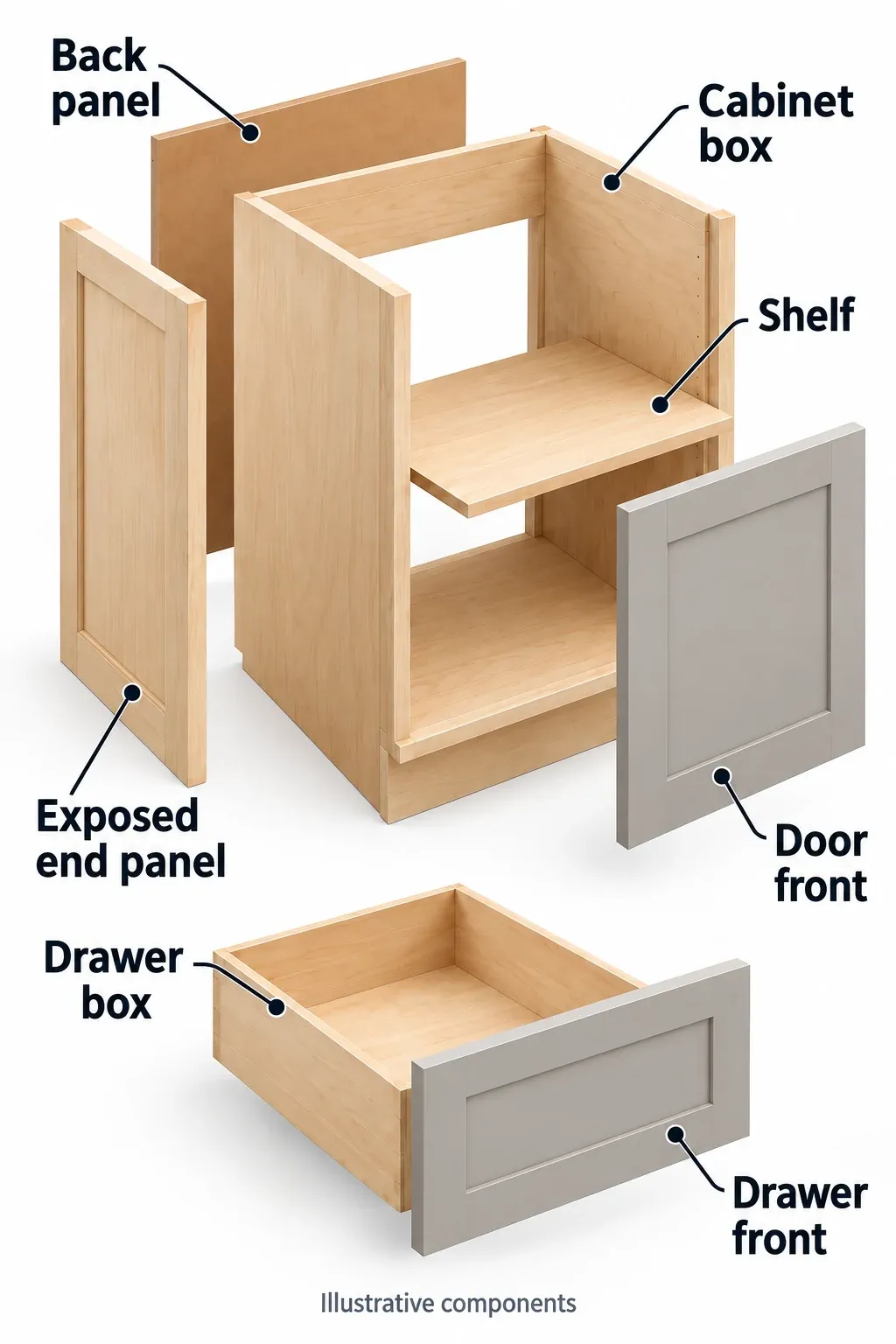
| Part | What it does | What the material description should cover |
|---|---|---|
| Box sides, bottom and top | Form the enclosure and connect to adjoining parts | Panel type, thickness, surface and joint details |
| Back | Closes the rear; its role in the assembly depends on the design | Material, thickness and how it connects to the box |
| Shelves | Support the intended contents | Panel, span, supports and any required load information |
| Drawer box and bottom | Hold contents and connect to the drawer slides | Side and bottom materials, joints, bottom support and drawer slide model |
| Doors and drawer fronts | Form the visible fronts of doors and drawers | Core or frame construction, finish, profile and hardware preparation |
| Exposed ends, fillers and toe kicks | Complete visible surfaces and fit the cabinet run to the room | Material, finish match, dimensions and attachment detail |
An exposed end is a visible cabinet side; a filler closes a gap beside a cabinet; a toe kick covers the recessed space below base cabinets. A decorative end panel may cover a box side without replacing it. Keep both in the cabinet list, with a reference and quantity for each unit. Otherwise, two quotes can appear to cover the same cabinets while one excludes the visible finishing pieces.
Know What the Substrate Is
A substrate is the material beneath an applied finish. It matters even when you cannot see it.
Plywood
Plywood is made from bonded wood layers. It is used in cabinet boxes, shelves and other components, with different cores and face options available.
The word alone does not identify the panel's grade, thickness or intended exposure conditions. A decorative face also does not establish what is inside the panel. Treat a plywood label as the beginning of the specification rather than a promise that every plywood cabinet is equivalent.
MDF
Medium-density fiberboard, or MDF, is made from wood fibers and a binder pressed into a panel. Its smooth surface and lack of a natural grain pattern make it useful for painted surfaces and machined door profiles.
MDF products have different properties. The selected board, door size, finish and fastening details still matter. Do not assume that a smooth painted front tells you how the box behind it is built. The MDF and Plywood Comparison explains how to compare the two by component.
Particleboard
Particleboard uses wood particles bonded into a panel. It is used for cabinet parts and shelving, often with a decorative surface applied.
Panel properties vary with the product and manufacturing process. Evaluate the specified board, edge treatment, joints and shelf supports together. Calling particleboard suitable or unsuitable without considering its use in the cabinet leaves out important construction details.
Solid Wood
Solid wood is used for parts such as door frames, face frames and decorative details. A door described as wood may combine a solid-wood frame with a different center panel.
Natural wood varies in grain and color and responds to changes in moisture. Record the species, construction and finish instead of assuming that the entire cabinet is solid lumber. Where appearance varies naturally, an agreed range of samples can communicate more than one idealized piece.
Separate the Surface from the Panel
A wood appearance can come from solid wood, real wood veneer or a printed decorative surface. These are different products even when their colors look similar.
| Surface | What the name describes | What remains to be specified |
|---|---|---|
| Wood veneer | A thin real-wood surface over a supporting material | Species, substrate, grain arrangement, coating and edges |
| Paint or lacquer | A coating system on the prepared part | Substrate, profile, color, sheen and coating reference |
| Thermally fused laminate, often called melamine or TFL | Resin-treated decorative paper fused directly to a panel | Panel, surface code, texture, finish on the back and strip covering the edges |
| High-pressure laminate, or HPL | A separately manufactured decorative laminate bonded to a substrate | Laminate grade, substrate, how it is bonded, and how the back and edges are finished |
| Thermofoil | A thermoformed decorative film over a shaped supporting panel | Film system, substrate, profile, back, and how the film wraps around or ends at the edges |
“Melamine versus plywood” often compares two different layers: a surface name and a panel name. Rewrite the options as complete combinations before judging them.
The Thermofoil and Laminate Guide explains the surface terms in more detail. Whatever the finish, review the finished component's face, edges and back. A surface sample alone cannot show how a finished door's corners or joints will look.
Water resistance also needs a defined scope. A wipeable face does not make the complete cabinet waterproof. Edges, holes, joints, service cutouts and the supporting panel remain part of the construction.
Use the desired result to narrow the specification. A smooth painted profile calls for a panel suited to machining and finishing; MDF's uniform surface is relevant here. Natural wood grain calls for a decision between solid-wood construction and veneer over a panel, followed by species and grain samples. Shelves need a panel and support arrangement suited to their span and intended contents. Near a sink, include the panel's intended exposure conditions and protection at plumbing cutouts and edges.
Keep Construction and Delivery as Separate Decisions
A framed cabinet has a face frame around its front opening; a frameless cabinet has no separate face frame. Neither term identifies the panel material. An inset door sits within the front opening, while an overlay door covers part of the cabinet front.
Compare Framed and Frameless Construction when reviewing openings, drawer space and hardware. Keep that decision separate from the material schedule so a change in construction does not silently change the specified panels.
RTA, or ready to assemble, describes a delivery format. Compared with RTA cabinets, assembled cabinets require less assembly after delivery. Either format still needs a defined material specification. The RTA and Assembled Cabinet Comparison covers the packing, labor and receiving work behind that choice.
Build a Component Material Schedule
Use a separate row whenever a component changes. For repeated kitchens, a shared schedule can cover the standard configuration, with exceptions identified by unit or room.
The fields below are a blank planning template, not a product specification.
| Component and cabinet reference | Substrate and thickness | Finish, profile and edges | Construction or hardware reference | Sample, requirements and unresolved items |
|---|---|---|---|---|
| Box sides, bottom and top; enter unit references | Enter each proposed panel | Identify inside, outside and edges | Current construction drawing | Record missing information |
| Back; enter unit references | Identify the back separately | Describe both faces and edges | Back-to-box connection | Record approval reference |
| Shelf; enter unit reference | Enter the proposed panel | Describe visible surfaces | Span and support arrangement | Record intended contents and load information needed |
| Drawer sides and bottom; enter unit reference | Use separate rows if materials differ | Describe each surface | Joints, bottom support and drawer slides | Record requirements and unresolved items |
| Door or drawer front; enter unit reference | Identify core or frame construction | Profile, finish, back and edges | Hinges, handles and drilling | Approved sample code |
| End, filler or toe kick; enter location | List separately from the box | Matches and deliberate differences | Dimensions and attachment | Approval reference |
An illustrative entry could read: “B01 door front; MDF, grade and thickness not yet selected; painted profile, back and edge finish to be defined; hinge model pending; color sample C01 approved for color only.” These are example references, not a George product offer. The entry makes clear that approving the color has not completed the door specification.
If an alternative quote changes the box panel but keeps the door finish, mark that change explicitly. If it omits the island end, identify the omission separately. The Quote Comparison Template helps keep those differences visible alongside delivery and installation exclusions.
Check the Specification Before Approval
Before approving production, work through the order from the unit list to the supporting documents:
-
Match cabinet references and quantities to the current layout.
-
Identify the material for each component, including backs and drawer bottoms.
-
Connect finish codes to physical samples and the surfaces they cover.
-
Confirm the details for exposed edges, cutouts, end panels and fillers.
-
Match hinges, drawer slides and other fittings to the selected components.
-
Record changes, unresolved items and who can approve them.
Approving a color confirms only the appearance details recorded in that approval. It does not approve an unspecified panel, prove a load rating or resolve an installation detail. Keep those decisions distinct so the production approval says exactly what was accepted.
When you are ready to discuss a project, prepare the layout, cabinet quantities and component schedule. Visit the Cabinetry and Wardrobe Page to review the category and its inquiry requirements.