The useful answer to sintered stone vs quartz depends on the product and the countertop you need to build. Check each product's stated uses and restrictions for the intended location. Then compare their care limits, finished edges, fabrication requirements, and complete order cost. A slab with attractive surface properties can still be a poor choice if its proposed openings, supports, or installation arrangements remain unresolved.
For an indoor kitchen or vanity, either category may provide suitable candidates. Outdoor exposure, a demanding edge detail, or destination restrictions can narrow that choice. Use the comparison below to turn a material preference into a product selection and an order that the supplier, fabricator, and installer can each price and review.
The fabricator is the business that cuts and finishes the slabs. It may be separate from both the slab supplier and the site installer.
Identify the Material and the Complete Product
Engineered quartz is manufactured from quartz particles combined with resin, pigments, and other ingredients. The formulation varies, so a familiar percentage quoted for one brand does not identify every quartz countertop. Natural quartzite is a quarried metamorphic rock. It belongs in a separate material comparison, despite the similar name.
Sintered stone describes a manufactured mineral surface consolidated through heat and pressure. Suppliers also use terms such as porcelain and ultracompact surface. These terms can overlap in sales conversations, but they do not establish identical composition, manufacturing methods, finishes, or permitted uses. Record the manufacturer's own product description.
Keep the following details together for each candidate:
-
Manufacturer, product family, design code, and composition information.
-
Actual slab thickness, slab dimensions, finish, and any mesh, backing, or reinforcement.
-
Stated countertop applications, indoor or outdoor use, and applicable restrictions.
-
The technical, fabrication, care, safety, and warranty documents for that product and market.
A backing or joined edge is part of the proposed construction, not a minor appearance option. Its compatibility with the slab, adhesive, and supports needs review. If the seller cannot identify the product behind a generic material name, keep it off the approved shortlist until the missing information is supplied.
Compare Use and Care Under the Same Conditions
Begin with your kitchen or bathroom routines: hot cookware, cleaning chemicals, repeated impacts around the sink, and sunlight exposure. Compare how each selected product handles those conditions. A general claim such as “durable” does not tell you which precaution matters.
| Decision | Sintered Stone Candidate | Engineered Quartz Candidate |
|---|---|---|
| Heat and sudden temperature changes | Read the product's care and appliance restrictions. A high firing temperature is not permission for unlimited hot-pan contact. | Check heat protection requirements. Resin-containing surfaces can be damaged by excessive heat. |
| Stains and cleaning | Compare the exact finish and approved cleaners. Low absorption does not establish resistance to every chemical or surface mark. | Review cleaning instructions for the chosen color and finish; textured and dark surfaces may show use differently. |
| Scratches and edge impacts | Check both face care and edge design. Scratch resistance does not establish resistance to a heavy object striking an edge. | Check cutting-board guidance and edge details. A familiar material still needs protection from sharp tools and impact. |
| Outdoor use | Require an explicit outdoor application statement and compatible installation materials. | Require a product specifically intended for outdoor exposure; do not extend an indoor range's approval. |
Heat Resistance Still Has Conditions
A slab's manufacturing temperature and a finished countertop's use conditions answer different questions. A hot pan heats a small area rapidly, while nearby material remains cooler. This temperature difference can create stress; cutouts, edges, and adjoining materials also affect the result.
The distinction appears in manufacturer guidance. Caesarstone's US care instructions require trivets or hot pads. Neolith's countertop manual also advises trivets to avoid sudden temperature changes. These are product examples, not evidence that every product in either category has the same limits.
Read a test result alongside the care document. Identify the tested material, finish, method, exposure, and reported outcome. A result under a specified laboratory exposure does not grant permission for every cooking appliance or an unrestricted service temperature. If the report covers a different finish or leaves the exposure unclear, record that performance as unverified for your selection. Keep the selected product's appliance and care conditions in the handover information.
Cleaning, Scratches, and Repairs Are Separate Questions
A hard surface can resist scratching yet still chip where a pan or dish strikes an exposed edge. Edge shape, workmanship, and the point of impact matter. A surface mark may also be metal transfer or residue rather than a scratch; aggressive scrubbing can damage the finish while trying to remove it.
For edges around sinks and other high-contact areas, review a physical sample of the proposed profile. Ask the fabricator how a chip would be assessed and what a repair could look like on that exact design. Surface decoration and the underlying body may differ, making a repaired area conspicuous. Do not assume either material will polish back to an invisible repair.
“No routine sealing” also does not mean “no care.” Caesarstone distinguishes the cleaning needs of its Polished finishes from Honed, Concrete, and Rough finishes. Some edge treatments have separate instructions. Choose a finish whose approved cleaning routine the user can maintain, and keep the surface, joint, and edge instructions distinct.
Outdoor Approval Belongs to the Product
Do not reject every engineered quartz product with a blanket indoor-only rule. Caesarstone identifies Solaris as an outdoor quartz collection. That exception does not make its indoor collections suitable outdoors or confirm availability through George.
For either category, outdoor selection includes the substrate, adhesives, joints, appliance clearances, and exposure conditions. A statement about the slab's resistance to ultraviolet (UV) light does not approve the entire installation. If an outdoor use statement or compatible installation detail is missing, hold that candidate for the outdoor location.
Approve the Full Surface and Finished Edge
A small sample helps judge color, touch, and reflection. It cannot show where a large vein will fall across an island, how two slabs meet, or whether the decoration continues through a visible edge.
Approve the design code and finish first. Next, link the actual slab identifiers and batch information to the piece layout. This drawing shows where each finished piece will be cut. Show visible faces, vein direction, seams, openings, and any waterfall return, meaning a vertical panel continuing down from the top. For a bookmatch, review the intended mirrored pair rather than assuming adjacent slabs will mirror each other.
Manufactured products can still vary between batches or thicknesses. If a replacement slab or a different thickness is proposed, return to the appearance approval. A matching code alone does not settle the visual result.
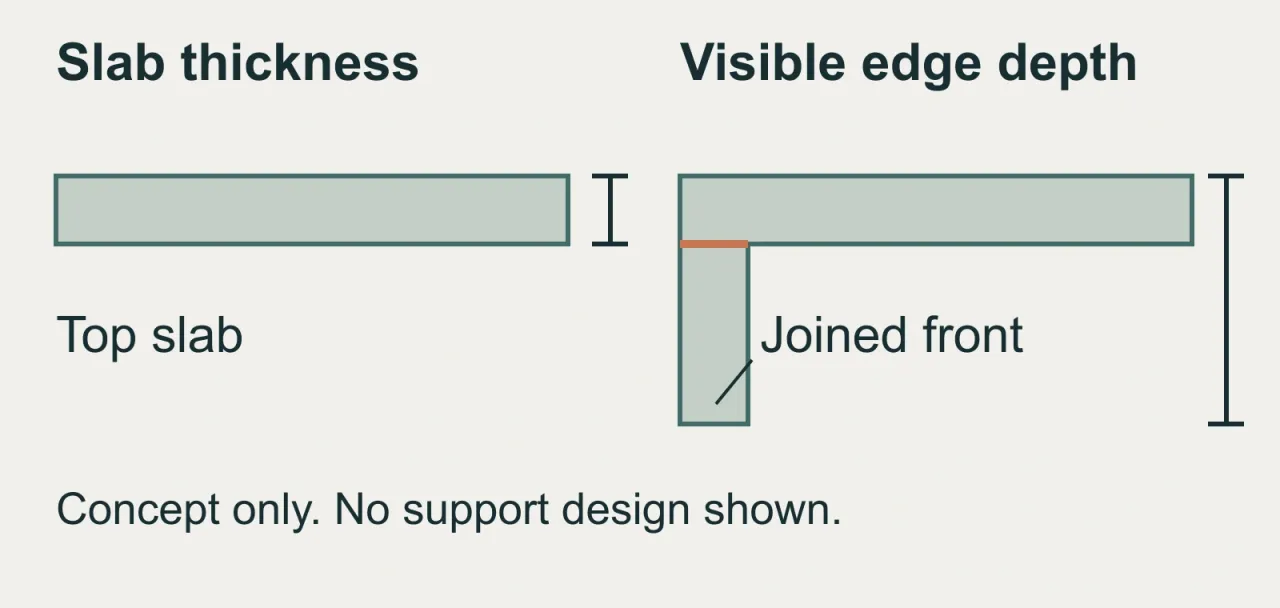
Specify slab thickness separately from visible edge depth. A deep front can be made by joining a front strip to a thinner top. That detail introduces a joint and may expose a different body color. It does not make the entire top equally thick or establish the support capacity.
Use a physical corner or edge sample to approve the visible joint, exposed body, finish, and profile. Record what the sample approves and what remains subject to the full slab layout. Photographs are useful references, but lighting and screens can change appearance.
Resolve Fabrication and Installation Before Releasing Cuts
The selected material must work with the piece geometry. A sink or cooktop opening removes material and leaves narrower sections around it. Sharp internal corners, unsupported areas, and handling stresses can increase breakage risk. Required radii, edge distances, support spacing, and overhang limits belong to the selected manufacturer's applicable instructions and the project detail.
Do not copy one brand's dimensions into another product's drawing. Even within a brand, thickness, application, reinforcement, and market can change the instructions. The fabricator should identify the document used and resolve conflicts with the manufacturer before fabrication.
| Interface | Record on the Coordinated Drawing | Responsible Review |
|---|---|---|
| Sink, faucet, and cooktop | Exact model, current template, mounting method, opening positions, and relevant clearances. | Fabricator coordinates with the fixture supplier and project designer. |
| Cabinets and support | Cabinet layout, level and support conditions, seams, overhangs, and separate sink or appliance support where required. | Project designer and installer confirm the support arrangement; fabricator checks compatibility. |
| Edges and joints | Actual slab thickness, visible edge depth, profile, joint locations, backing, and approved adhesive system. | Fabricator details the assembly; designer approves appearance and project requirements. |
| Site fit and access | Final measurements, wall conditions, delivery route, lifting access, and any site joints. | Named site measurer and installer confirm fit and handling arrangements. |
Use the Cabinet Component Schedule to identify the cabinetry below the top. Cabinet material selection does not, by itself, approve countertop support.
Agree who measures the site and who authorizes the final fabrication drawing. Preliminary plans can support an initial quotation, but an unresolved sink model or unverified site dimension should remain an open item. Do not release the affected piece for cutting until the responsible person approves it.
Also distinguish a slab shipment from a finished-top shipment. Cutting locally leaves fabrication and some handling risks with the local team. Shipping finished pieces requires approved dimensions earlier, suitable packing around openings and edges, and a route that can accommodate the pieces. Neither arrangement automatically includes installation.
Check Destination Eligibility and Fabrication Safety
Product legality and safe processing need review before the order is fixed. A low-silica description or a safety data sheet is not, by itself, proof that a product is permitted for every destination and activity.
Australia illustrates why the destination matters. It prohibits the manufacture, supply, processing, and installation of engineered stone benchtops, panels, and slabs within its defined scope; import controls also apply. The definition has composition criteria and excludes sintered stone and porcelain products that do not contain resin. A finished countertop is not automatically outside the ban simply because cutting happened elsewhere. Check the applicable authority's current requirements for the identified product.
Cutting, grinding, or polishing stone products can create hazardous dust. This is a different exposure from normal use of an intact installed surface. Have the fabricator review the product's safety information and the rules governing its work, including any planned site adjustment. Choosing a different category name does not replace that assessment.
Compare the Complete Order Scope
Compare quotations against the same piece plan and responsibility schedule. A low slab price may exclude usable-area losses, difficult openings, joined edges, or packing. An installed-top quotation may already include some of those items.
| Quotation Part | What Must Be Comparable |
|---|---|
| Material and yield | Identified product, finish, thickness, usable slab dimensions, slab count, layout allowance, and spare pieces. |
| Fabrication | Cutting, openings, finished edges, joins, polishing or approved treatments, backing, and reinforcement within the quoted scope. |
| Other materials | Supports, adhesives, sealants, profiles, and fixture-related parts, with inclusions and exclusions. |
| Packing and transport | Piece labels, edge and opening protection, crate arrangement, freight basis, unloading, and responsibility for transit damage. |
| Site work and handover | Measurement, fitting, lifting, installation, connections by relevant trades, acceptance checks, and care documents. |
Gross slab area is not finished coverage. Vein placement, trimming, seams, and usable offcuts determine yield. Have the fabricator price the approved layout rather than dividing the top's area by a nominal slab area and assuming no loss.
Mark unpriced work as excluded or pending. Assign a person to obtain a price for each pending item. An unknown installation charge is not zero.
Read the warranty separately. Identify the covered product and use, and check any conditions for installer qualifications or warranty registration. Then check whether removal, labor, transport, or reinstallation costs are included. Agree who receives a claim when the slab supplier and installer are different businesses.
Use the Quote Comparison Worksheet to reconcile the offers, and the Building Materials Procurement Checklist for the wider approval and shipping sequence.
Close the Selection with an Order Record
Before releasing the order, bring four decisions together:
-
Product and use: The identified product, finish, thickness, destination, and application are supported by the relevant documents.
-
Appearance: The approved sample, slabs or batch references, piece layout, seams, and finished edge agree.
-
Fabrication and site fit: The fixture models, final measurements, support details, and drawing revision have named approvers.
-
Commercial scope: Each quotation states who supplies, fabricates, transports, unloads, installs, and handles defects within its scope.
At receipt, compare piece and crate labels with the order and approved drawings. Record visible chips, cracks, wrong finishes, shortages, or damaged packaging before the affected pieces move into fabrication or installation. Keep the supplier's claim procedure and the agreed acceptance record with the order.
To discuss candidates, use George's Stone Materials and Countertop Inquiry. Send the intended use and destination, product or sample references, piece plan, quantities, and delivery stages. Mark preliminary dimensions and say whether you need slabs or fabricated pieces. Confirm the exact product documents and each party's work in the quotation before proceeding.