Custom kitchen cabinet costs become comparable when the offers price the same cabinets and the same work. Match the unit list, drawings, component materials, fronts, hardware and finishing pieces before judging the total. Then distinguish cabinet supply from delivery, assembly and installation.
There is no single price that represents every custom kitchen or destination. This guide shows how to read a cabinet quotation and build a useful comparison. The worked figures are hypothetical, not George prices, market averages or a project budget.
Define What “Custom” Includes in Each Offer
Custom can refer to changed widths, special heights, a selected door profile, nonstandard finishes or a fully developed layout. The word does not identify the complete specification or prove a higher-performing cabinet.
Ask each supplier to price the same drawing revision and unit schedule: a list of cabinet IDs, sizes and quantities. Keep the following choices visible:
| Configuration | What to match before comparing price |
|---|---|
| Cabinet count and geometry | IDs, sizes, corner arrangement, wall/tall units and island sides |
| Component materials | Box, back, shelves, drawer boxes and fronts, including thicknesses and edges |
| Fronts and finish | Door profile, surface, visible backs/ends, color, sheen and grain arrangement |
| Hardware | Hinge/runner models and mounting parts, handles, lifts and storage fittings |
| Finishing pieces | Fillers, exposed end panels, toe-kick covers, trim and appliance panels |
| Interfaces | Sink/appliance openings, ventilation, countertop support and service access |
| Delivery state | Ready to assemble or assembled; fitted and loose parts |
A drawer base and a two-door cabinet can have the same outside dimensions while pricing different parts and hardware. A tall pantry with a pull-out system is different from one with fixed shelves. Keep those differences in an alternative offer rather than treating them as a lower price for the same cabinet.
Use the Cabinet Material Guide to check component descriptions. It avoids a misleading comparison between a surface label in one quote and a box material in another.
Ask What the Price Unit Actually Measures
A price per linear foot or meter describes a length, but does not explain everything included along that length. Ask how the supplier counts corners, tall units, islands and gaps, and whether the stated rate covers base cabinets, wall cabinets or both.
A 10-foot run with a tall appliance unit and drawer stacks is a different package from a 10-foot run of simple base cupboards. Length alone cannot make those offers comparable.
For a project order, request itemized prices by cabinet ID and separate lines for panels and special fittings. If the supplier uses a length-based price, obtain the included configuration and counting method as well. Keep the resulting package total with that definition.
Do not convert a published local installation range into an overseas factory price. Its labor, taxes, service scope, layout and measurement method may differ from your order.
Check the Pieces That Complete the Kitchen
End panels and fillers can look minor in a rendering but still require material, finish matching, fabrication and fitting. Identify each piece and the visible surfaces it must match.
Handles, drawer organizers, pantry mechanisms, lighting parts and appliance fronts also need explicit status. “Accessories included” is insufficient if the selected mechanism and its mounting parts are unidentified.
For each required item, mark included, separately priced or unconfirmed. If an offer substitutes a different component, resolve the technical change before adding a guessed price adjustment.
Countertops deserve their own boundary. State who supplies the slab or surface, measures the final site, fabricates edges and cutouts, supplies necessary support, transports it and installs it. A quote for cabinet boxes does not automatically cover any of that work.
If countertops are local, keep the cabinet-to-countertop coordination task visible. If they travel with the cabinets, identify the dimensions and approvals needed before fabrication, along with the packing and handling scope.
Worked Example: A Lower Cabinet Price Can Produce a Higher Subtotal
All figures below are fictional U.S. dollar amounts for illustrating comparison only. They are not current offers, George prices or market benchmarks.
Assume 12 kitchens of type K-A, with eight cabinet units each: 12 × 8 = 96 cabinets. For this arithmetic example, assume both suppliers can meet the same agreed layout, materials, finish and hardware requirement. The required drawer/pantry fittings and finishing panels are also identical. This assumption is not an approval of any real product.
Both offers exclude countertops, sinks and appliances. Both use the same assembly format. The table compares cabinet supply and export packing only; collection, transport, import charges and installation are outside it.
| Required package element | Offer A | Offer B |
|---|---|---|
| 96 cabinet units: initial quoted cabinet line | $48,000 | $51,600 |
| Specified hinges and drawer slides | $2,400 additional | Included in cabinet line |
| Required fillers and exposed end panels | $1,800 additional | Included in cabinet line |
| Specified drawer/pantry storage fittings | $1,200 additional | $1,200 additional |
| Export packing | $900 additional | Included in cabinet line |
| Comparable cabinet-and-packing subtotal | $54,300 | $52,800 |
A totals $48,000 + $2,400 + $1,800 + $1,200 + $900 = $54,300. B totals $51,600 + $1,200 = $52,800. B is $1,500 lower for this defined supply scope, even though its initial cabinet line is higher.
If A's panels were still unquoted, you would have $52,500 of known costs plus unconfirmed panels. You could not treat $52,500 as a complete comparable subtotal. Nor would B's lower supply subtotal prove a lower installed cost: the excluded stages still need prices.
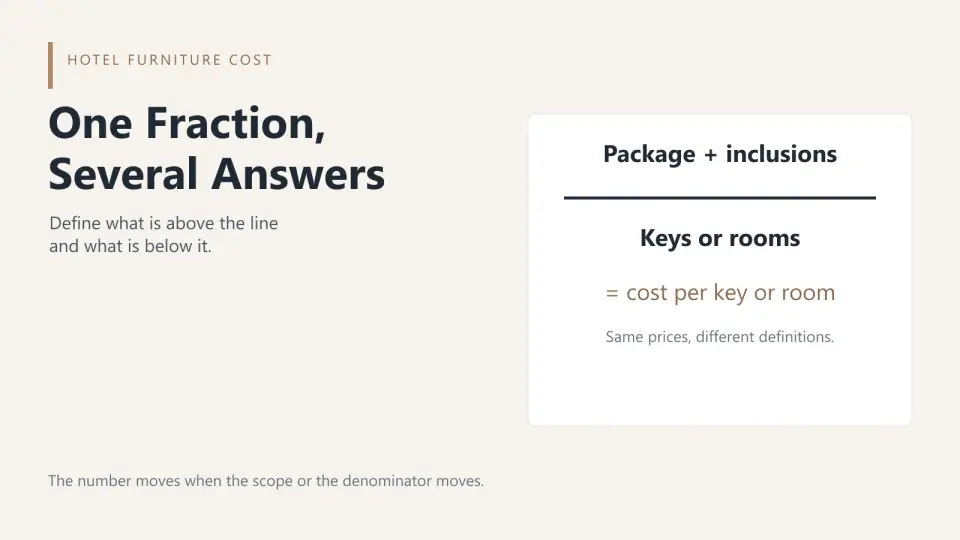
This example shows the effect of different inclusions. It does not suggest a target price per cabinet, kitchen or unit length. Your comparison needs actual written offers against your own schedule.
Extend the Comparison to Delivery and Installation
Keep three cost stages separate:
| Stage | Cabinet-specific scope to establish |
|---|---|
| Cabinet supply | Agreed units, fronts, hardware, finishing pieces, assembly state and packing |
| Delivery to a named place | Actual packed cargo, collection, freight, insurance, clearance, applicable import charges, local handling and unloading |
| Installed kitchen scope | Local assembly if needed, positioning/fixing, panels and trim, countertop work, appliance/trade connections and final adjustment |
Record the named delivery place and the included services. “Delivered” leaves an unanswered question if it does not identify unloading, access into the building or the party receiving the shipment.
For an imported order, ask the customs professional to review the actual goods, origin, producer/exporter, destination and entry date. Relevant duties, taxes and trade measures must come from that review. Ready-to-assemble packing is not evidence of a lower duty rate.
Use the General Quote Comparison Worksheet for currency conversion, quoted additions, estimates, shared shipment costs and unknown amounts. Use the same cost-status labels in your cabinet comparison.
The RTA and Assembled Cabinet Guide helps define assembly separately from installation. Ask the local team which tasks its price includes so supplier assembly and local labor are neither omitted nor counted twice.
Reduce Cost Through Named Alternatives
Ask for the price effect of a specific change, keeping other requirements fixed. For example, compare a selected pull-out pantry with an agreed shelf arrangement, or revise a decorative end treatment while retaining the specified fronts and hardware elsewhere.
Each option should show the affected cabinet IDs, changed components, price difference, appearance or function tradeoff, and any effect on drawings or timing. A lower-cost option that removes needed access, support or installation compatibility has not met the same requirement.
Avoid an instruction such as “make it cheaper” without a revised scope. It can produce an unnamed board, hinge or finish substitution that is difficult to review and impossible to compare fairly.
Also review the conditions beside the price: quote validity, payment events, drawing/sample approval, change charges, production-start conditions and replacement responsibilities. A replacement part can leave a cost gap if the replacement commitment excludes its freight and local fitting.
For the wider ordering sequence, use the Cabinet Procurement Guide.
Request a Cabinet Cost Comparison for Your Project
Review Cabinetry and Wardrobe and Discuss the Cabinet Package with the layout or cabinet schedule, quantities, material and hardware preferences, appliance interfaces, destination and required dates.
Include the scope you want priced: supply only, delivery to a named place, or any separately requested services. Mark unconfirmed items so the discussion can produce an identifiable offer rather than another total built on different assumptions.